
A major milestone in sustainable landscape governance has been achieved in southern Cameroon with the formal establishment of three Municipal Landscape Management Commissions (MLMCs) in the municipalities of Mintom, Djoum, and Oveng. Between 10 and 12 June 2026, the three councils officially installed these permanent governance bodies, known locally as Commissions Communales de Gestion du Paysage (CCGP), marking a decisive system transformation from planning and consultation to institutionalized local action.
Supported by the GEF-8 Dja Landscape Project under the technical supervision of the United Nations Environment Programme (UNEP) and implemented by Cameroon’s Ministry of Environment, Protection of Nature and Sustainable Development (MINEPDED) through its implementing partner ECO-ph, the establishment of the commissions demonstrates that the project’s governance framework has moved beyond concept and design into operational reality.
From Transitional Structures to Permanent Institutions
The creation of the Municipal Landscape Management Commissions is the culmination of a carefully sequenced process that began in February 2026. Mintom was the first municipality to establish an Ad Hoc Committee for landscape governance (Mintom signed the first Ad Hoc Committee decision) in the Dja Landscape; Djoum followed with Municipal Decision No. 010-2026 and Oveng came at the tail of the trio through the ad hoc committee.
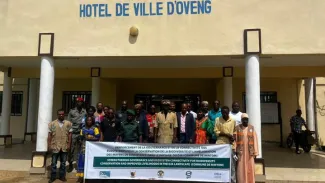
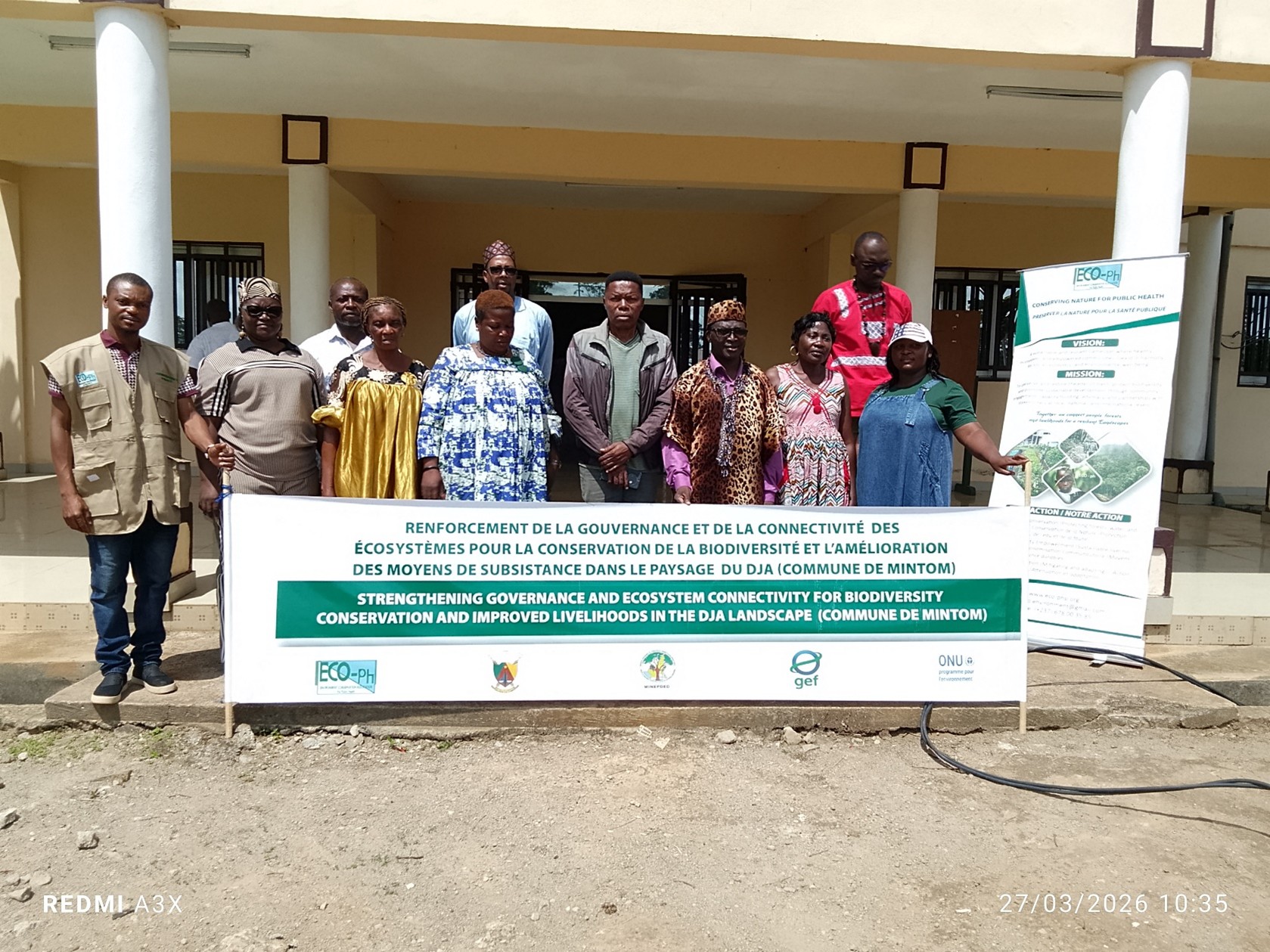
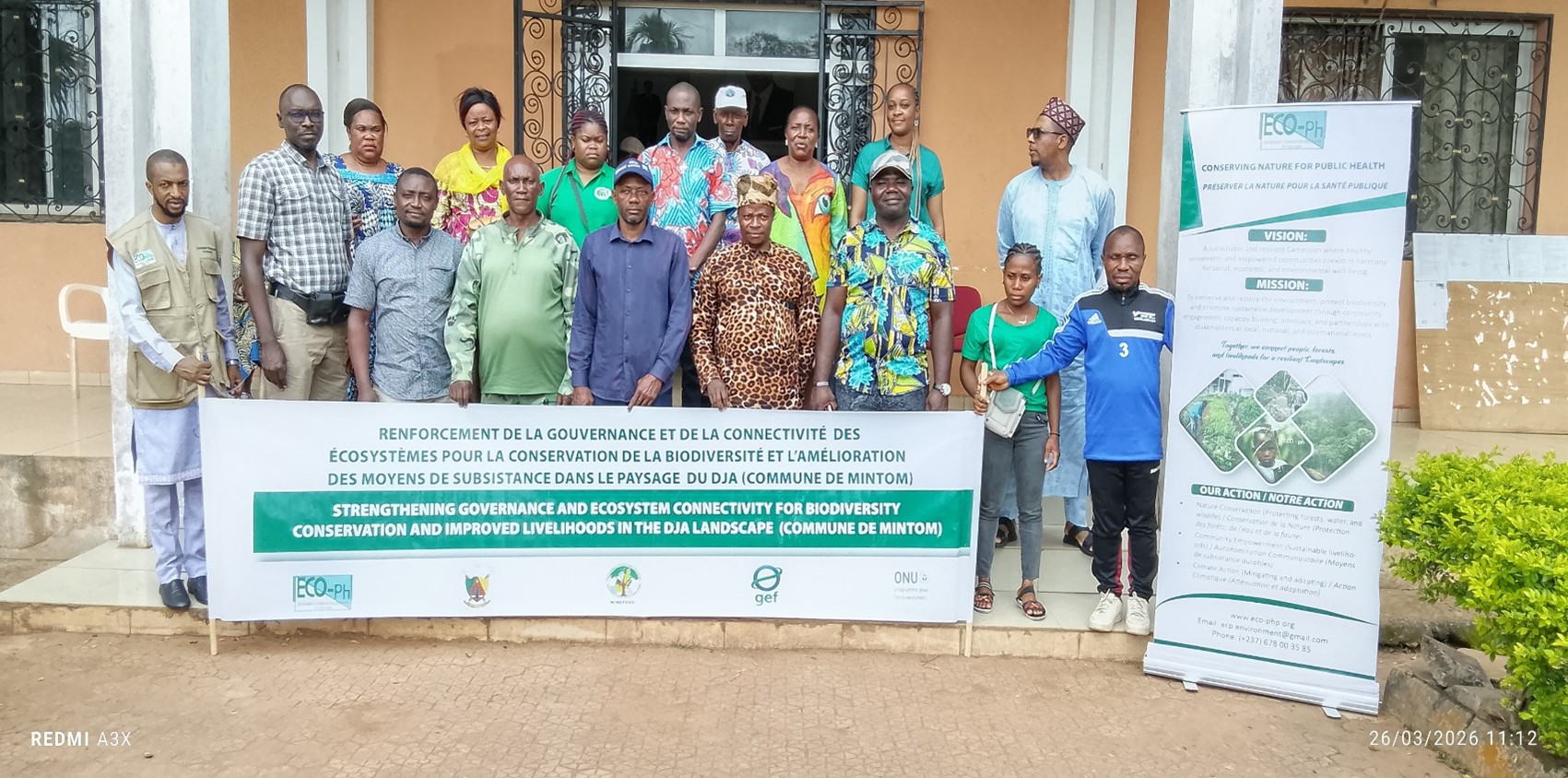
These temporary committees were mandated to review, refine, and validate the institutional framework for the future commissions. Between February and March 2026, dedicated reflection committees worked to develop governance structures, operational procedures, and institutional arrangements. Their recommendations were subsequently validated through stakeholder workshops held in Mintom on 25 March, Djoum on 26 March, and Oveng on 27 March 2026.
The process reached its formal conclusion in June, when each Divisional Officer presided over the installation of the newly constituted commissions. The ceremonies took place in Mintom on 10 June, Djoum on 11 June, and Oveng on 12 June 2026, following the signing of municipal decisions by the respective mayors formally establishing the commissions and adopting the validated framework
documents.
Inclusive Governance at the Local Level
Each Municipal Landscape Management Commission comprises 17 members and is chaired by the Mayor or a designated representative, with the Municipal Secretary-General serving as rapporteur.
The composition of the commissions was intentionally designed to ensure broad representation and inclusive decision-making. Membership includes municipal councilors from landscape villages, representatives of farmers, hunters, and cooperatives, traditional chiefs from riverside communities, women’s associations, civil society organizations, private sector actors, youth representatives, and Indigenous Baka community members.
Particularly noteworthy is the formal inclusion of Indigenous Baka representatives; one man and one woman in each commission alongside women and youth representatives. This reflects commitments made throughout the Free, Prior and Informed Consent (FPIC) process and ensures that historically marginalized groups have a recognized voice in landscape governance.
Across the three municipalities, more than 50 individuals now serve on the commissions, while 126 participants attended the installation workshops, underscoring the broad local ownership of the initiative.
A New Governance Architecture for the Dja Landscape
The Municipal Landscape Management Commissions serve as the operational backbone of local landscape governance. Their mandate includes coordinating stakeholder participation, advising on land-use planning and territorial delimitation, supporting biodiversity conservation initiatives, climate change adaptation and mitigation through natural based solutions, integrating landscape priorities into municipal development plans and budgets, and promoting dialogue to prevent and resolve land-use conflicts.
To ensure accountability and continuity, each commission is required to meet at least once every quarter. Provisions have also been established to guarantee functionality; should the commission president fail to convene a meeting within six months, two-thirds of members may request the intervention of the local administrative authority to do so.
Conflict resolution mechanisms have been embedded within the governance framework at multiple levels. Village-level disputes are addressed through traditional leadership structures, municipal disputes are managed by the commissions themselves with administrative recourse where necessary, and broader landscape-level disputes fall under the authority of the future Dja Landscape Management Committee.
The commissions constitute the municipal tier of a broader two-level governance system. At the landscape scale, the future Comité de Gestion du Paysage du Dja (CGP-Dja) will provide strategic oversight through a decentralized cooperation framework linking all participating councils. This mechanism is anchored in Article 94(1) of Law No. 2019/024 and is reinforced by the Dja Landscape’s designation as a Priority Development Zone (Zone d’Action Prioritaire – ZAP) under Law No. 2011/008, enabling coordinated and differentiated policy implementation across sectors including forestry, agriculture, water, and energy.
Building Capacity and Securing Long-Term Sustainability
With the commissions now formally established, attention turns to operationalization. Each body will develop its own internal rules of procedure and receive targeted capacity-building support in local governance, natural resource management, and conflict resolution.
Three-year action plans will be developed to guide implementation, while municipalities will begin integrating landscape priorities into local planning and budgeting processes. Mintom has already scheduled its first statutory commission meeting for July 2026.
A key priority during the first year will be the development of sustainable financing mechanisms. Discussions are already underway on options including direct municipal contributions and innovative financing arrangements through the Special Council Support Fund (FEICOM), including source-level deductions allocated to a dedicated joint landscape account.
At Djoum, the installation process was complemented by participatory cartographic studies in the villages of Akontangan, Melen Bulu, and Akom Zaman. Community members worked alongside technical teams to identify degraded areas and prioritize restoration interventions, demonstrating the evidence-based and participatory approach that will underpin future commission activities.
Laying the Foundation for Landscape-Wide Governance
The establishment of the three Municipal Landscape Management Commissions represents far more than an administrative achievement. These institutions are the foundational building blocks of a landscape-wide governance system that will ultimately unite municipalities, government agencies, Indigenous Peoples, civil society, and development partners around a shared vision for sustainable management of the Dja Landscape.
From the first stakeholder consultations and FPIC processes, through the work of the ad hoc committees, to the signing of legally binding municipal decisions, the Dja Landscape governance journey has advanced steadily and deliberately.
Today, that journey has reached a significant milestone. The governance framework is no longer confined to policy documents and project plans. It now exists as permanent, functioning institutions rooted in local government structures and community participation.