
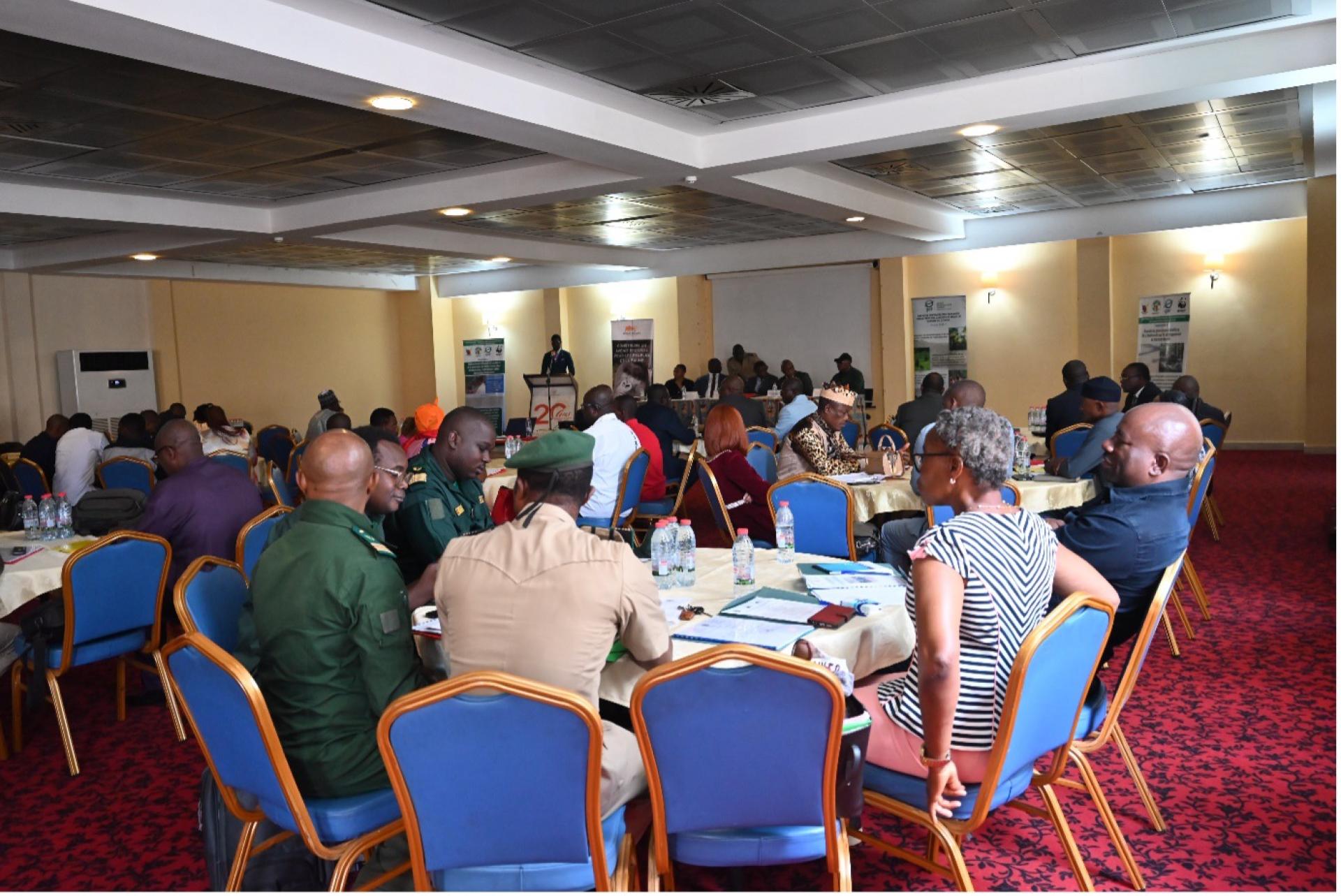
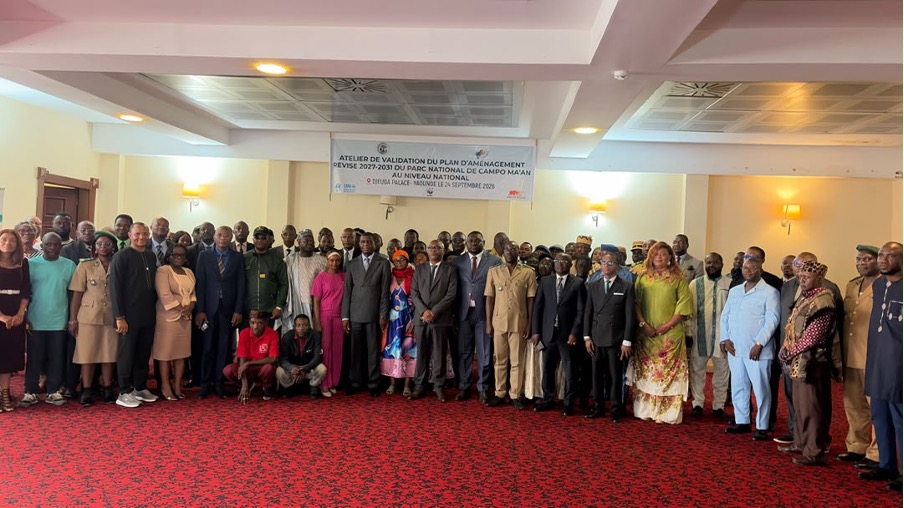
On September 24, 2026, key stakeholders met at the Djeuga Palace Hotel in Yaoundé to officially consolidate the next phase of conservation planning for the Campo Ma’an National Park (CMNP) and its peripheral zone. The meeting, convened under the authority of the Ministry of Forestry and Wildlife (MINFOF), was organized in partnership with the African Wildlife Foundation (AWF) under the GEF-7 Integrated Management of Cameroon’s Forest Landscapes in the Congo Basin project, a national project of the GEF-7 Congo Basin Sustainable Landscapes programme and part of the wider UNEP-led Congo Basin Landscapes Initiative (CBLI). The meeting culminated in the validation of the revised Plan of Management (2027–2031) and its accompanying Business Plan, following consultations that progressively involved stakeholders at national, regional, departmental and local levels.
The workshop marked the concluding step in a series of consultations and validation meetings conducted at different territorial levels. These included local validation meetings in Ma’an, Akom 2, Nieté and Campo (27 April, 29 April and 5–6 May 2026); divisional meetings in Océan (26 May 2026 in Kribi) and Vallée du Ntem (3 June 2026 in Ambam); and a regional validation session in Ebolowa on 21 July 2026. Presided over by Mr. NYONGWEN Joseph, Secretary General of MINFOF, the national workshop brought together decision-makers and technical stakeholders from government institutions, local authorities, traditional leadership, civil society, Indigenous Peoples’ representatives, women and youth associations, international partners, development agencies and the private sector.
More than just a formal review, the national workshop also served as a platform to ensure that the revised management plan reflects real-world constraints and priorities identified during the consultation process, including concerns raised by communities living near the park and those directly affected by conservation decisions.
What the validation sought to achieve
The workshop’s overall goal was to present and validate the revised CMNP management plan (2027–2031) and its business plan at the national level, while collecting observations and contributions from all relevant parties to support final approval.
In practical terms, the validation session aimed to:
- Familiarize participants with Cameroon’s institutional framework and national directives governing the development and validation of management and conservation plans for protected areas.
- Present the current biodiversity conservation context and the broader management situation of CMNP and its peripheral zone.
- Review the programs and activities proposed in the plan, ensuring they respond to identified challenges and constraints.
- Close the consultation process and move toward final validation of the management plan and business plan.
Key presentations and structured discussion
During the proceedings, participants were first presented with :
- The process of developing and revising management plans in Cameroon and how actor concerns were integrated.
- The current context and perspectives for managing CMNP and its peripheral zone.
- The plan d’affaire supporting the revised management plan for the 2027–2031 period.
Following these presentations, discussions focused on concrete technical, administrative, and implementation issues, including:
- Availability and clarity of CMNP boundary mapping, taking into account the limits of the four concerned divisions.
- Mechanisms for sharing ecological monitoring data and wildlife inventory findings with local communities.
- The budget structure, including alignment between sources of financing and different expense categories.
- The need to identify additional financing to support implementation of planned activities.
- Opportunities and approaches for eco-tourism activities in CMNP.
- Conflict management mechanisms between humans and wildlife.
- Community-focused initiatives, including sensitization efforts to support civil registration, such as birth registration for children in indigenous communities.
Resolution: validation achieved, enforceability to follow
At the end of the exchanges, a formal resolution was adopted. The key outcome states that:
- The revised Plan of Management 2027–2031 for the Campo Ma’an National Park and its peripheral zone is validated, but it will become fully executable only after the signature of a Ministerial decision by the MINFOF.
Results: strengthened ownership and clearer implementation pathways
The workshop produced outcomes designed to reinforce conservation governance and practical implementation capacity. In particular, participants agreed that:
- Stakeholders gained a better understanding of CMNP’s current biodiversity conservation realities and management conditions.
- The proposed programs and activities were presented in response to issues raised by local actors and were supported through national validation.
- The plan was consolidated through stakeholder observations and contributions.
- Relevant suggestions, concerns, and expressions of consent from the parties involved will be considered for the definitive approval process.
By validating the CMNP management plan and Business Plan at national level, the GEF-7 project in Cameroon, implemented within the wider framework of the UNEP-led Congo Basin Landscapes Initiative, is helping establish a structured roadmap for conservation action, improved governance and sustainable financing for 2027–2031 with the support of the Global environment Facility (GEF). With formal ministerial follow-up still required to make the plan enforceable, the next phase will focus on implementation readiness, including data sharing with communities, improved budgeting and resource mobilisation, conflict mitigation, and strengthening ecotourism to support long-term ecosystem protection.