

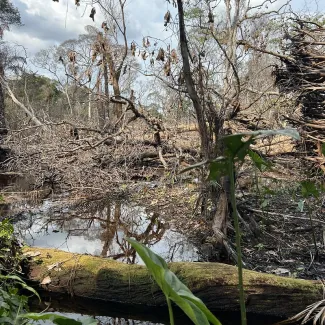
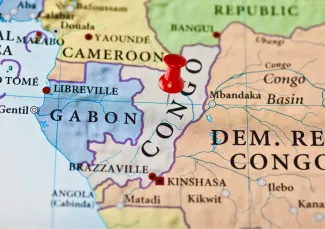
Funded by the German International Climate Initiative (IKI) (January 2022-December 2027) and implemented with partners including the Food and Agriculture Organization (FAO) and GRID Geneva, the Congo Basin Peatlands project "Securing crucial biodiversity, carbon and water stores in the Congo Basin Peatlands by enabling evidence-based decision-making and good governance" aims to protect the world's largest tropical peatland complex in the Central Congo Basin, in the Lac Tele/Lac Tumba landscape in the Cuvette Centrale, by promoting evidence-based decision-making and good governance to support a biodiversity-friendly development pathway in the RC and DRC primarily.
Core to the initiative is establishing sustainable land use practices, strengthening governance frameworks, and fostering community participation. The project emphasizes the development of innovative monitoring systems, stakeholder platforms across national, district, and local levels, and integration of peatland management into national policies. It also promotes alternative livelihoods and risk reduction measures, ensuring that conservation efforts are socially equitable, culturally sensitive, and economically viable. Governance is strengthened by establishing cross-sectoral platforms and identifying policy barriers to sustainable peatland management
Congo Basin Peatlands project core pillars
Peatland Conservation and Sustainable Management
Protect and restore peatlands to preserve biodiversity, water resources, and carbon stocks.
Evidence-Based Policy and Governance
Develop and integrate policies, land-use plans, and institutional frameworks that support sustainable peatland use.
Stakeholder Engagement and Livelihoods
Involve local communities and stakeholders through awareness, capacity-building, and promoting sustainable livelihoods.
Monitoring, Data Systems, and Knowledge Sharing
Establish state-of-the-art monitoring tools and data platforms to support decision-making and transparency.
Financial Mobilization and Investment
Promote market-based mechanisms, climate finance, and investment opportunities for peatland protection.
Regional and International Collaboration
Foster cooperation among Congo Basin countries and share lessons learned globally to scale impacts.
Sections
Objectives
- Protect and sustainably manage peatlands in the Congo Basin, preserving biodiversity, water, and carbon.
- Improve decision-making with better monitoring, data sharing, and stakeholder participation.
- Integrate peatlands into national land-use plans through policy reforms.
- Support local communities with sustainable livelihoods and reduce threats like drainage and illegal extraction.
- Build strong institutions at all levels for long-term peatland conservation.
Key Components
- Monitoring & Data: Develop systems to track biodiversity, water, and carbon.
- Policy & Governance: Incorporate peatlands into land plans and build stakeholder platforms.
- Community & Livelihoods: Support local practices and indigenous rights.
- Ecosystems & Biodiversity: Protect species, manage human-wildlife conflict, and strengthen resilience.
- Risks & Safeguards: Implement policies to manage biodiversity, social, health, and safety risks.
- Capacity & Outreach: Train institutions and engage the public through media and regional cooperation.
Threats
- Environmental threats: Drainage activities, illegal logging, and land conversion degrading peatlands.
- Biological threats: Biodiversity loss, human-wildlife conflicts.
- Socio-economic threats: Unsustainable livelihoods, marginalization of local communities, and inadequate capacity to manage ecosystems.
- Financial & Political risks: Limited financial sustainability, lack of political will, and institutional capacity gaps.
- Health risks: COVID-19 and other disease outbreaks, impacting project implementation and stakeholder engagement
Interventions
- Establishing and operationalizing peatland monitoring systems.
- Conducting policy dialogues and integrating peatland issues into national development frameworks.
- Implementing community-based livelihood projects aligned with ecological sustainability.
- Developing biodiversity action and species management plans.
- Providing training, technical assistance, and capacity-building for government agencies and local stakeholders.
- Facilitating multi-sector stakeholder platforms to enhance coordination.
- Launching awareness campaigns and knowledge-sharing platforms
Outcomes
- Enhanced understanding of peatlands' ecological and socio-economic value.
- Institutionalized policies mainstreaming peatland conservation.
- Reduced illegal drainage, logging, and land-use change activities.
- Improved biodiversity status and ecosystem health in the region.
- Increased stakeholder capacity for sustainable land management.
- Strengthened financial mechanisms to support conservation efforts.
- Elevated regional and international profile for Congo Basin peatlands
Areas of intervention
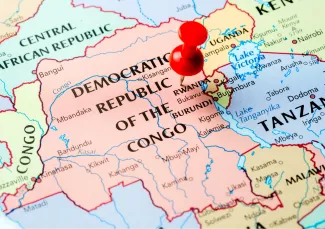
Story Maps
Storymap 1: The Congo Basin Peatlands, A Global Treasure
Storymap 2: Nurturing Early Career Researchers to Safeguard the Congo Basin
News
Community Radio Revolutionizes Conservation Education in Congo's Peatlands
Planning with Water in Mind: A Science-Based Tool for Protecting the Congo Basin Peatlands
The IKI Congo Basin Peatlands Project achieved substantial progress in 2025 across governance, biodiversity conservation, sustainable livelihoods, climate and hydrological modelling, and policy integration. Despite security and logistical constraints, the project strengthened institutional coordination, improved community engagement, and advanced scientific tools essential for sustainable peatland management in the Lac Télé–Lac Tumba landscape.
Governance & Enabling Environment
Eleven cross-sectoral platforms were established across both countries. These structures now enable coordinated decision-making among government, NGOs, researchers, private sector actors, and communities.
Twenty-two consultation meetings were planned, and half were already completed. These meetings helped formalize stakeholder engagement at multiple administrative levels.
A total of 120 stakeholders were actively engaged with balanced representation. This diversity strengthens ownership and transparency in the decision-making process.
National Advisory Committees in both countries entered the formal establishment phase. This marks an important institutional step toward long-term governance of peatlands.
Scientific Task Forces were created, including a first meeting held in DRC. These expert bodies will guide technical decisions throughout implementation.
Land-use decision criteria were revised to include peatland ecosystem health metrics. This ensures future planning decisions integrate carbon storage, hydrology, and biodiversity considerations.
Satellite imagery revealed a concerning 15% deforestation rate in some areas of RoC. This data provides strong evidence for urgent policy reform and monitoring efforts.
Biodiversity Conservation & Ecological Monitoring
Baseline wildlife surveys documented elephants, great apes, crocodiles, waterbirds, and hippos in RoC. These data help define conservation priorities for threatened species.
Monitoring systems using camera traps and digital tools were launched in DRC. This improved the accuracy and frequency of wildlife and habitat assessments.
Five species conservation action plans entered development. They will guide long-term management of priority species across both countries.
Twenty-one community hunting monitoring sessions were conducted in RoC. These findings directly inform the ongoing reserve management planning process.
Sustainable Livelihoods
- More than 2,000 farmers in DRC received training in improved agricultural practices. Women represented nearly half of all participants, strengthening gender inclusion.
- Twenty multiplication fields were established to produce improved crop varieties. These fields now serve as demonstration sites for sustainable agriculture.
- In RoC, 250 producers were trained on cocoa, beekeeping, and fisheries. This training increased local capacity to adopt conservation-friendly livelihoods.
- Cocoa yields increased by 25% in targeted pilot communities. This demonstrates the economic potential of sustainable production systems.
- Six apiaries and five fishponds were successfully established. These initiatives create new income streams while minimizing pressure on peatland ecosystems.
- Twenty-five villages formally engaged in adopting peatland-friendly livelihood options. Their participation reflects strong community commitment to long-term conservation.
Land-Use Planning & Management
- Two major land management plans advanced significantly, including the Lac Télé Reserve plan. These plans provide a structured framework for sustainable resource governance.
- Twenty-seven consultations were held with local communities in RoC. Village leaders validated the discussions through formal signatures.
- DRC finalized methodological documentation for developing land-use management plans. This creates a standardized approach for future landscape planning.
Water, Climate & Decision-Support Systems
- The Hydrological Decision Support System (HDSS) was fully developed and made accessible online. It integrates hydrological, climatic, and development scenarios for decision-makers.
- Hydrological modeling revealed water table depths between 0.5 and 1.2 meters. This data is essential for predicting peatland vulnerability.
- Climate and development scenarios were incorporated into the HDSS. This allows governments to evaluate how future pressures may impact water and peat resources.
- National workshops were held in both capitals to validate the system. These events strengthened institutional ownership and technical understanding.
- A prototype peatland monitoring system using SEPAL and MapX was deployed. It provides a unified digital platform for real-time ecosystem monitoring.
- Sixty percent of trained participants achieved high proficiency in monitoring techniques. This demonstrates strong capacity-building outcomes.
High-Resolution Mapping & Policy Integration
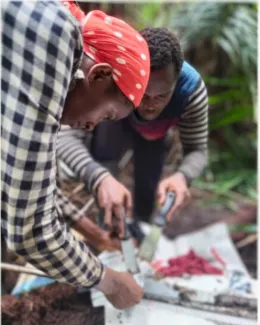
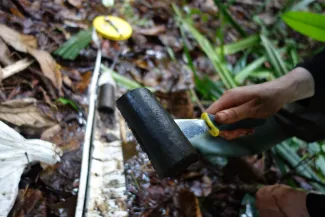
- Three peatland field campaigns were completed to produce a high-resolution map. Data analysis is now underway to finalize the national peatland layer.
- Twelve young researchers from DRC and RoC were trained in advanced mapping and field techniques. This ensures future national capacity to maintain and update peatland datasets.
- Peatland data began integration into NBSAPs and national biodiversity reports. This will help both governments meet global environmental commitments.
Safeguards, Inclusion & Human Rights
- FPIC was systematically applied across all community activities. This guarantees that local populations provide informed and voluntary consent.
- More than 1,700 people benefited from project activities, including 649 women. This demonstrates strong community reach and inclusiveness.
- Gender-responsive approaches were implemented in all activities. Women were specifically supported in agriculture, monitoring, and local planning.
- Disability inclusion was ensured through the Human Rights-Based Approach. Persons with disabilities were offered equal opportunities to participate in project activities.
Coordination, Synergies & South–South Cooperation
- The project strengthened synergies with CAFI, GEF-7, GEF-8, JICA, and GIZ. These collaborations enhance efficiency and reduce duplication.
- Coordination mechanisms across institutions and partners were reinforced. This improved coherence among workstreams and national authorities.
- Cooperation between DRC and RoC intensified, especially in data sharing and joint planning. This South–South dynamic supports regional peatland conservation.
Risk Management & Adaptive Implementation
- Activities in DRC were rescheduled due to security challenges. Adaptive planning ensured continuation of essential field activities.
- The project monitored the proposed Epena–Mboua road in RoC, which could threaten peatlands. Field observations confirmed no construction progress to date.
- The Mid-Term Evaluation was launched in June 2025, with fieldwork completed in October. The final report is expected in early 2026.