
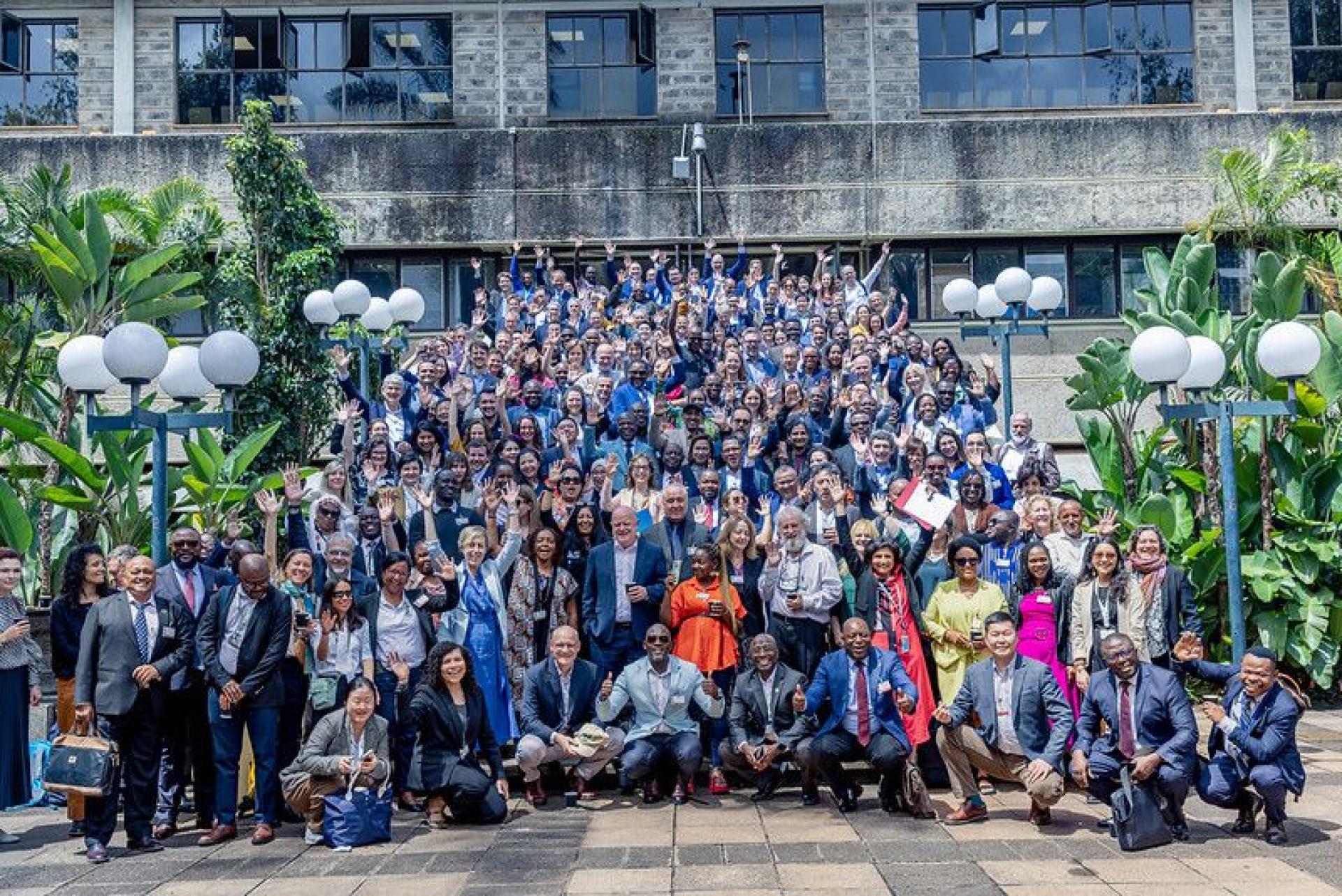
The GEF Global Forum for Integrated Programs, held at the United Nations Office in Nairobi this April 13th to 17th, Convened by the Global Environment Facility (GEF) in collaboration with the United Nations Environment Programme (UNEP), brought together practitioners, policymakers, and partners working across biodiversity, climate, finance, land and livelihoods. While the diversity of themes was broad, the discussions converged around a shared question: what does it actually take to make integrated approaches work in practice?
Across sessions, a clearer picture emerged – not of new concepts, but of how different pieces must work together to deliver lasting results on the ground.
Integration is about timing not just design
One of the strongest messages from the forum was that integration does not happen automatically. It depends on when and how it is introduced. Where key dimensions -such as pollution, biodiversity, or climate- were embedded early in project design, outcomes tended to be more coherent and more durable. Where they were not, gaps emerged later, often undermining results.
This reinforces a practical lesson: Integration is less about adding components, and more about getting the sequencing right from the start.
Governance connects the system
As discussion moved from design to implementation, governance emerged as the central connector. Throughout the sessions, it was not treated as a matter of structure alone, but as the way institutions, actors, and decisions are meaningfully linked. This includes clearly defined roles and responsibilities, effective coordination across sectors and governance levels, as well as mechanisms that ensure data is translated into decision making.
Without these connections, tools and data remain underutilized. With them, they become operational. In this sense, governance is what transforms integration from a design principle into a functioning system.
Communities anchor sustainability
Another consistent thread was the role of communities – not only as participants, but as actors shaping outcomes. Discussions highlighted the need to move beyond participation toward deeper inclusion in decision-making, sustained engagement, and locally driven accountability.
This shift reflects a broader understanding that inclusion is not a box to check, but a redesign of how decisions are made and who holds influence. It also requires rethinking what acounts as evidence- moving beyond participation metrics to indicators that capture whether community priorities are reflected in decisions and outcomes.
In several CBLI supported landscapes, including in Cameroon and DRC, local landscapes governance platforms and municipal committees bring together community representatives, local authorities and sector actors. These structures help anchor decision-making locally ad create space for communities to influence how land and resources ar4e managed over time; helping align local priorities with broader environmental objectives.
Alongside these governance mechanisms, partnerships with organizations such as the Rainforest Alliance support more sustainable production systems, including agroforestry practices. By linking restoration and land use planning with income-generating value chains, these approaches provide tangible incentives for farmers while reducing pressure on forests. See how it works in practice. Discussions also emphasized that inclusion requires time, resources, and accountability – including investments in long-term engagement, community led monitoring, and feedback mechanisms that ensure accountability flows both upwards to donors and downward to communities.
Together, these elements help ensure that communities are not only consulted, but actively shaping and sustaining outcomes over time.
Finance follows function.
The forum made it clear that finance, while essential, does not operate in isolation. Innovative financing mechanisms depend on credible institutions, clear governance structures, and a pipeline of viable, well-prepared projects. In practice, this means that finance tends to follow function.
Where systems are in place, investment can scale. When they are not, financing remains limited. This reinforces the importance of investing upstream -in institutions, coordination, and project preparation – as part of integrated approaches.
At the same time, discussions also underscored a distributional challenge: economic benefits often do not reach those who bear the costs. Too often, poorer communities carry the biggest burden of human wildlife conflict without seeing any economic benefits in conserving wildlife and habitats. This highlights the need for Innovative financial tools to be deliberately designed in a way that communities living alongside wildlife benefit economically from conservation outcomes.
Learning is part of implementation
Monitoring, evaluation, and learning were also reframed during the forum- not as reporting requirement, but as a core part of implementation.
Discussions emphasized the need to understand how systems evolve, identify early signals of change, and use coordination platforms as space for adaptation. This is particularly relevant for complex landscapes, where outcomes emerge over time and are shaped by multiple interactive factors.
Best practice approaches, highlights a more operational way of working:
Establishing strong baseline information to understand context
Using the evidence to inform decisions and planning early on
Applying interventions while continuously monitoring their effects
And adjusting actions based on what us observed
In line with the mitigation hierarchy (avoid, reduce, rehabilitate, offset), learning is embedded throughout implementation- not only to measure impacts, but to guide how they are managed and improved. Monitoring systems should trigger adaptive responses when needed, rather than simply recording notes.
In this context, monitoring supports real-time decision-making, helping programs respond to changing conditions, stakeholder dynamics, and implementation challenges.
Learning therefore is not a separate activity. It is an operational function that enables integrated approaches to adaptive, relevant, and effective in the long term.
From complexity to practical action.
While integrated approaches are often described as complex, discussion at the knowledge café on cross-countries integrated synergies- held by the Congo Basin Landscapes Initiative (CBLI) - highlighted a more grounded perspective. One practical insight was that progress often depends on keeping things simple enough to act; starting with what is feasible, using ‘just enough data’ and sequencing action realistically.
In peatland landscapes of the Congo Basin, for instance, early efforts have shown that combining simple governance arrangements with targeted livelihood activities can create the conditions for broader, more integrated action over time.
Integration, then, is not about doing everything at once - It is about connecting the right elements, at the right time, in the right way.
What this means in practice and for the CBLI
Taken together, these discussions point to a common understanding:
- Integration requires early design and sequencing
- Governance provides structure for connection
- Communities ensure continuity and ownership.
- Finance supports scaling once systems are in place and makes sure it reaches the communities
- Learning enables adaptation over time.
These reflections are closely aligned with the intended approach of the CBLI. Working with partners, and with the support of the Global Environment Facility (GEF) and the International Climate Initiative (IKI) under UNEP’s leadership, the CBLI brings together governance, communities, biodiversity, livelihoods, and partnerships to support integrated landscapes approaches in the Congo Basin region.
The forum provided an opportunity to both contribute to and draw from a broader body of experience – reinforcing that integration is less about new frameworks, and more about how existing elements are connected, sequenced and sustained over time.
Looking ahead
The discussion in Nairobi did not point to a single model or solution. Instead, they highlighted an important direction: focus on practical implementation, invest in connection and coordination, build on what already exists, and keep approaches simple and adaptable. This reflects a growing shift – from merely designing integrated approaches to making them work over time.