
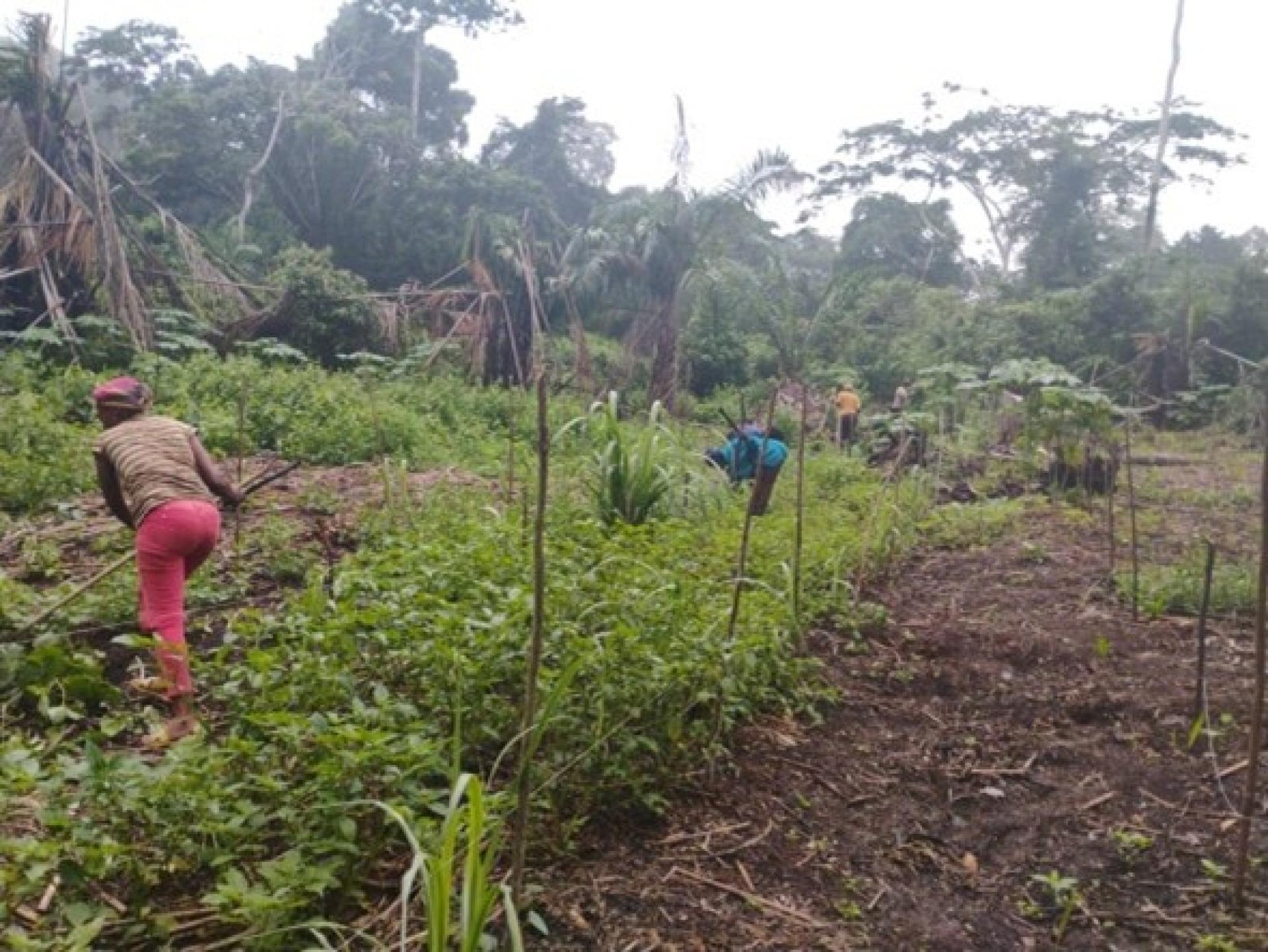
What began as a small medicinal plant garden behind the Dioula Health Centre has grown into a community-led restoration effort spanning more than 2,500 hectares.
Led by the women of the Association Essoungue: l’Épanouissement des Familles de Dioula (AEEFD), the initiative combines community forestry, restoration, traditional knowledge, and livelihoods. With support from the GEF-8 Dja Landscape Project, the association has secured a 2,546-hectare community forest, mobilized 137 households, planted 690 trees, and established a medicinal plant garden containing 18 species and 3,200 plants.
The results are contributing directly to the Dja Landscape Project’s target of bringing 10,000 hectares under restoration.
Securing a community forest
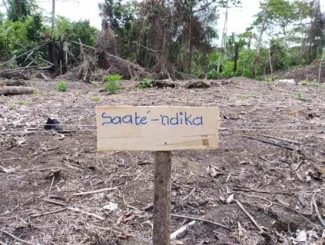
A major milestone came on 25 March 2026, when Cameroon’s Minister of Forestry and Wildlife signed Provisional Management Agreement No. 0016/CPG/MINFOF/SETAT/SG/DF/SDFC/SC/SRPSG, granting AEEFD a 2,546-hectare community forest in the Moloundou subdivision of Boumba-et-Ngoko Division, East Region.
The forest is divided into three blocks, situated around a tributary of the Boumba River and bordered to the east by the Mbandamé–Ndjong road. The area lies within the national domain and is not covered by another forestry exploitation title.
The provisional agreement gives the association two years to work with the forestry administration to prepare a Simple Management Plan, after which a definitive management agreement can be signed. During this period, the Ministry has committed not to allocate the area to another use.
For the women of Dioula, securing the forest provides more than legal recognition. It creates a foundation for community decisions about restoration, sustainable use, and the sharing of benefits from forest resources. The community forest project mirrors the establishment of a village health center, recognizing that the health of the people of Dioula and the health of the forest surrounding Dioula are intertwined.
From maps to action
With the community forest secured, AEEFD and its partners have identified areas in need of restoration.
Through village assemblies and participatory mapping, community members identified degraded land, old farm fallows, cleared areas, and places where valuable tree species had disappeared. The process brought 137 households into the initiative.
The community also played a central role in deciding which species should be restored. Rather than relying on a standard planting list, residents selected trees and plants according to their ecological, economic, cultural, and medicinal importance.
The selected species include sapelli (Entandrophragma cylindricum), bush mango (Irvingia gabonensis), safou or African plum (Dacryodes edulis), bitter kola (Garcinia kola), cocoa (Theobroma cacao) and avocado (Persea americana). Ebony (Diospyros crassiflora) and ayous (Triplochiton scleroxylon) are also planned for future planting.
690 trees in the ground
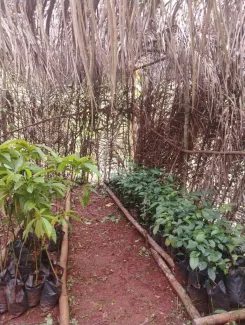
The association’s nursery is already producing tangible results.
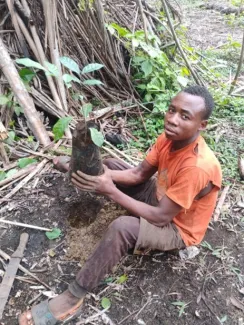
By early 2026, seedlings had outgrown their nursery bags and were ready to be planted. Volunteers organized the transport and distribution of seedlings, with 13 community members including eight women and five men, taking part in planting activities in April and May 2026.
A total of 690 trees were planted: 450 cocoa, 153 avocado, 55 sapelli, 32 bitter kola
The nursery is now being restocked. Members are preparing new planting bags, collecting wild seedlings from the forest, purchasing additional plants and sowing seeds. Sapelli, ebony and ayous will be added as their seeds become available.
Young people are also playing an important role, helping with watering, weeding, potting, and other nursery activities. In Dioula, restoration is increasingly becoming a community and household effort rather than the responsibility of a single group.
A medicinal garden rooted in traditional knowledge
The association’s restoration work began with an even smaller piece of land: a 55-by-43-meter plot, about 2,365 square meters behind the Dioula Health Centre. The goal of the medicinal garden is to promote health through knowledge of traditional medicine and healing practices, in combination with the industrially-produced medicines provided by the pharmacy at Dioula’s Health Center.
The land for the medicinal garden was donated by Thomas Ndjoumbè, a 74-year-old village notable and respected traditional healer. After clearing and preparing the site, members of AEEFD worked with traditional healers to identify and collect medicinal plants from the surrounding forest.
The garden now contains 18 medicinal species and 3,200 plants. Members maintain the nursery beds through regular watering and weeding, while an access path has been opened to connect the garden to the village.
The initiative is designed to serve both health and livelihoods. Medicinal plants can support the Dioula Health Centre while sales of non-timber forest products can help generate income for medicines, supplies and other community needs.
Restoration that supports livelihoods
The Dioula initiative demonstrates how restoration can address several community priorities at once.
The community forest provides a framework for sustainable forest management and the recovery of degraded areas. Fruit and agricultural trees such as cocoa, avocado, safou and bitter kola can contribute to household food security and income, while native forest species help restore ecological functions and habitat.
The medicinal garden brings another dimension by connecting forest conservation with traditional knowledge and local healthcare.
Together, these activities support Component 2, Output 2.2 of the GEF-8 Dja Landscape Project, which promotes forest restoration and sustainable forest management through community forestry while recognizing the rights and priorities of Indigenous Peoples and local communities.
The next chapter
The work is only beginning.
In the coming months, AEEFD plans to sow additional sapelli, ebony and ayous seeds, complete the delimitation of degraded restoration areas, transplant seedlings into the community forest and prepare the Simple Management Plan required for the definitive community forest agreement.
From a small medicinal garden to a 2,546-hectare community forest, the women of Dioula are demonstrating how local leadership can turn restoration plans into action.
Their experience shows that when communities have both the rights to manage their forests and the tools to restore them, a garden can become the first step towards a healthier and more resilient landscape.
The activity’s impact on individual households, on women and men, and on local community health will be assessed following the harvest and sale of community forest products.