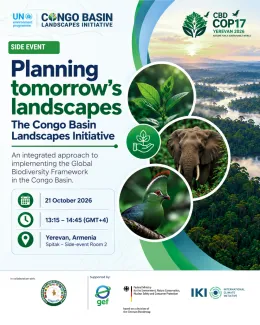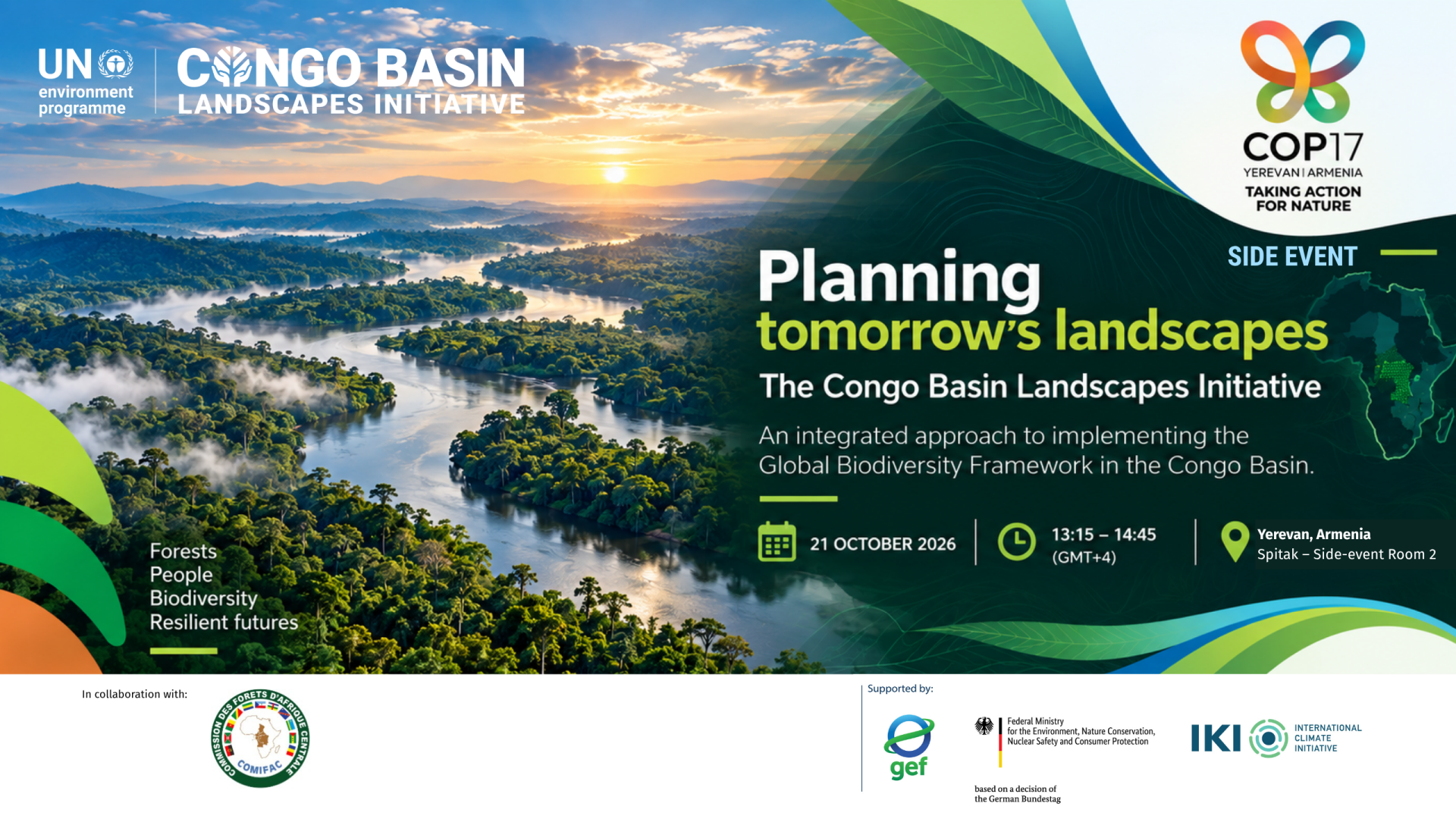
An integrated approach to implementing the Global Biodiversity Framework in the Congo Basin.
Join COMIFAC and UNEP for a high-level discussion on how integrated landscape approaches can help translate the Kunming-Montreal Global Biodiversity Framework into action across the Congo Basin.
The session will showcase practical results and innovations from the Congo Basin Landscapes Initiative, including the enhanced Integrated Land Use and Landscape Planning Methodology (ILUMP), Natural Capital Accounting, biodiversity and habitat management, Indigenous Peoples and Local Communities’ participation, and regional cooperation. Speakers from governments, regional institutions and technical and financial partners will share experiences, lessons and opportunities for scaling action across the region.
Sections
The Congo Basin is the second-largest tropical forest massif on the planet. It hosts exceptional biodiversity, globally significant carbon stocks - estimated at 30 gigatonnes in the peatlands - and provides essential ecosystem services for the well-being of more than 130 million people.
The Congo Basin Landscapes Initiative (CBLI) is a multi-country initiative designed and implemented by UNEP to reverse environmental degradation through integrated, landscape-based approaches. Financed by the GEF (GEF-7 and GEF-8) and Germany’s International Climate Initiative (IKI), it is implemented across eight countries: Cameroon, Central African Republic, Republic of Congo, Democratic Republic of Congo, Gabon, Equatorial Guinea, Angola and São Tomé and Príncipe.
The programme is structured around five pillars: integrated land-use planning, targeted habitat management, empowerment of Indigenous Peoples and Local Communities (IPLCs), knowledge management, and regional coordination.
Implementation of the Kunming-Montreal Global Biodiversity Framework (KMGBF) now requires innovative approaches capable of simultaneously integrating biodiversity conservation, climate change adaptation, socio-economic development and sustainable natural resource management.
Against this backdrop, COMIFAC, with the technical and financial support of its partners UNEP, USFS and WCMC, has developed an enhanced Integrated Land Use and Landscape Planning Methodology (ILUMP).
This methodology, which represents a major evolution of the 2015 regional guidelines, now integrates:
- climate change-related risks and opportunities;
- Natural Capital Accounting in accordance with the international SEEA framework;
- ecosystem services as a basis for land-use and development decisions;
- effective participation of Indigenous Peoples and Local Communities;
- a multi-sectoral and multi-scale approach to spatial planning;
- adaptive monitoring mechanisms based on the best available scientific knowledge.
This side event will provide an opportunity to demonstrate how the Initiative, through its strategic components and complementary financing from GEF and IKI, is contributing concretely to implementation of the Global Biodiversity Framework and to transforming landscapes in the Congo Basin.
The presence and support of Ministers of Environment from Congo Basin countries, together with the involvement of ECCAS, will demonstrate political ownership and the commitment of regional institutions to the Initiative.
Organisers
The Central African Forests Commission (COMIFAC) and the United Nations Environment Programme (UNEP), within the framework of the Congo Basin Landscapes Initiative (CBLI), supported by the Global Environment Facility (GEF) and the International Climate Initiative (IKI).
Technical partners
U.S. Forest Service (USFS), UNEP World Conservation Monitoring Centre (UNEP-WCMC), World Bank, UNDP, WWF-US, IUCN, Rainforest Alliance.
To present the overall achievements of the Congo Basin Landscapes Initiative and position the ILUMP methodology as a central and integrating tool for implementing the Kunming-Montreal Global Biodiversity Framework.
Specific objectives
The side event will:
- present the innovations introduced through the ILUMP methodology and its integration into national processes;
- demonstrate the Initiative’s progress in habitat management, combating wildlife crime and zoonotic disease surveillance;
- highlight the programme’s contribution to empowering IPLCs and engaging the private sector;
- share initial implementation experiences and lessons learned from programme implementation in Central Africa;
- promote scientific and technical cooperation among Parties, regional organisations and development partners;
- mobilise technical and financial support for scaling up the activities of the Congo Basin Landscapes Initiative.
- Parties to the Convention on Biological Diversity
- CBD Secretariat
- Ministers and government representatives from Congo Basin countries
- Regional organisations, including COMIFAC and ECCAS
- UN agencies
- Technical and financial partners
- Scientific and research institutions
- Natural resource and protected-area managers
- Civil society organisations and Indigenous Peoples’ networks
- Private-sector representatives
- What are the Initiative’s concrete results in biodiversity conservation, combating environmental crime and sustainable forest management?
- How is the programme strengthening the participation of Indigenous Peoples and Local Communities in landscape governance?
- What lessons can be shared with other tropical regions on integrated programme approaches and blended GEF/IKI financing?
- How can the Initiative’s successes be sustained and scaled beyond its current phase?
Key Messages
- The landscapes of the Congo Basin are where global commitments on biodiversity, climate and sustainable development are translated into action.
- The Congo Basin Landscapes Initiative demonstrates that an integrated, multi-country and multi-agency programme, supported by complementary GEF and IKI financing, is essential to achieving the objectives of the Global Biodiversity Framework.
- Empowering Indigenous Peoples and Local Communities is a fundamental pillar of sustainable landscape governance.
- Regional cooperation, facilitated by COMIFAC and ECCAS, is an essential lever for managing transboundary landscapes.
Expected results
At the end of the event:
- the overall achievements of the Congo Basin Landscapes Initiative will be officially presented to the international community;
- the ILUMP methodology will be recognised as a key tool for implementing the KMGBF;
- Parties will have an overview of the operational tools and good practices developed in Central Africa;
- new scientific and technical partnerships will be initiated;
- the visibility of COMIFAC and UNEP as sub-regional centres supporting scientific and technical cooperation under the CBD will be strengthened;
- a strong political signal will be sent in favour of regional cooperation and support for the Congo Basin Landscapes Initiative.
High-level political engagement, demonstrated through the participation of Ministers of Environment and ECCAS, is essential to sustaining the achievements of the Initiative.
Date: 21 October 2026 | Duration : 90 minutes
Venue: Spitak - Side-event Room 2
| Time | Duration | Session | Proposed speaker(s) | Content |
|---|---|---|---|---|
| 13:15–13:20 | 5 min | Welcome and introduction | Moderators (COMIFAC and UNEP) Chouaibou Nchoutpouen, Deputy Executive Secretary, COMIFAC Fabrice Inkonkoy, Programme Management Officer, UNEP | Welcome participants and present the agenda and objectives of the session. |
| 13:20–13:30 | 10 min | Opening remarks | Hervé Martial MAIDOU, Executive Secretary, COMIFAC Inger Andersen, Executive Director, UNEP | Opening remarks highlighting the importance of the Congo Basin, the vision of the Initiative and the catalytic role of GEF and IKI financing. |
| 13:30–13:35 | 5 min | ECCAS address | Maxime Nzita Nganga Di Mavambu, Commissioner in charge of Environment, Natural Resources, Agriculture and Sustainable Development, ECCAS | Remarks on the role of ECCAS as the regional political conduit, co-chair of the Congo IP Steering Committee, and its commitment to coordinating environmental initiatives in Central Africa. |
| 13:35–13:50 | 15 min | Ministerial remarks: Political support for the Initiative | Minister of Environment of Cameroon – Pierre Hélé Minister of Environment of the Democratic Republic of Congo – Marie Nyange Ndambo Minister of Environment of Gabon – Maurice Ntossui Allogo | Short five-minute interventions from three Ministers of Environment from Congo Basin countries expressing their support for UNEP’s work and the Congo Basin Landscapes Initiative. |
| 13:50–13:55 | 5 min | Address by the GEF Secretariat | Pascal Martinez, Representative of the GEF Secretariat | Presentation of the GEF’s role in financing the Initiative, synergies between GEF-7 and GEF-8, and financing prospects for the region. |
| 13:55–14:05 | 10 min | Main presentation: The Congo Basin Landscapes Initiative – An integrated management model | Juan Carlos Vasquez, Head of Unit, Biodiversity, People and Landscapes, UNEP | Overview of the Initiative, its strategic components, major achievements and alignment with the KMGBF, with the ILUMP presented as the central thread. |
| 14:05–14:15 | 10 min | Innovation focus: The ILUMP methodology and Natural Capital Accounting | Melissa de Cock, UNEP-WCMC Chouaibou Nchoutpouen, COMIFAC focal point | Detailed presentation of the ILUMP methodology, integration of natural capital, climate and customary rights, with implementation examples from Cameroon and Congo. |
| 14:15–14:30 | 15 min | Panel discussion: Results and impacts of the Initiative | Representative, Rainforest Alliance – Private-sector engagement and value chains Joseph Itongwa, Regional Coordinator, REPALEAC – IPLC empowerment Representative, WWF – National implementation in Cameroon | Moderated panel discussion. Each partner presents three minutes of concrete results from their respective component, followed by a moderated exchange. |
| 14:30–14:40 | 10 min | Country and partner testimonies | National focal point from a Congo Basin country (e.g. Cameroon, DRC or Congo) Haman Unusa (Cameroon) Kikumbi Pascaline Mbangu (DRC) Representative of the World Bank or UNDP | Short presentations on national implementation experiences and synergies between national and regional projects. |
| 14:40–14:45 | 5 min | Conclusion and next steps | Hervé Martial MAIDOU, COMIFAC Juan Carlos Vasquez, UNEP | Summary of the key messages, announcement of next steps (GEF-8, GEF-9 and sustainability) and closing thanks. |