
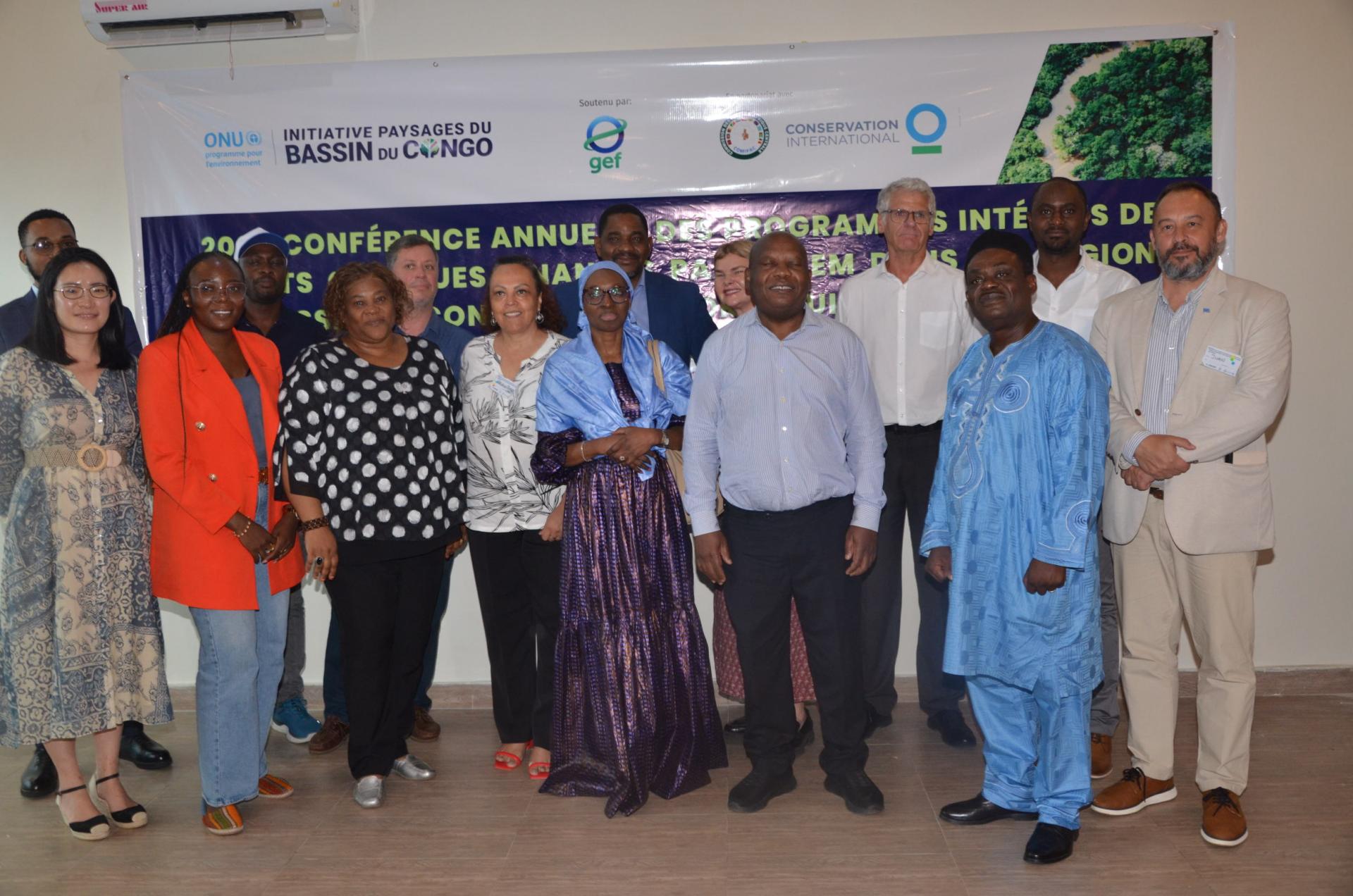
The landmark 2025 Annual Conference of the GEF-funded Critical Forests Integrated Programmes in the Congo Basin and the Guinean Forest Regions held in June in Kribi, Cameroon has set the stage for an ambitious new chapter in African forest conservation. The Conference saw the launch of the GEF-8 Congo Forest Integrated Programme and the GEF-8 Guinean Forest Integrated Programme, which adopt an expanded approach under the Amazon and Congo Critical Forest Biomess Integrated Programmes (IPs).
Building on lessons learned from the GEF-7 Congo Basin Impact Programme operational since 2021, the GEF-8 Forest IP, led by UNEP in the Congo Basin under the Congo Basin Landscapes Initiative signifies a maturation of regional forest conservation that transforms cross-border dialogue into concrete, scalable action.
Representing a combined investment from the GEF and other partners of $586 million, these two GEF-8 Programmes adopt an expanded approach that transforms cross-border dialogue into concrete, scalable action for reshaping how Africa protects its forest heritage.
Building on Success: From GEF-7 to GEF-8
Presentations at Kribi focused on lessons learned around, for example, integrating natural capital accounting into land use management planning, and cross-border judicial cooperation to combat wildlife trafficking. These lessons learned will be instrumental as the CBLI transitions to GEF-8, scaling collaborative approaches and institutional mechanisms across the broader Congo Basin region.
Lessons learned: Applying Natural Capital Accounting to enhance Land Use Management Planning
A key component of the Congo Critical Forest Biome (IP) funded under GEF-8 is the innovative application of climate finance, building, for example, on the natural capital accounting approach that enriched land use management plans in the GEF-7 programme.
By leveraging proven natural capital accounting methodologies and expanding them through innovative climate finance mechanisms, the GEF-8 programme represents a maturation of conservation financing that transforms environmental assets into sustainable economic opportunities for forest-dependent communities.
Bringing together research, training and regional judicial cooperation to combat wildlife trafficking
In the area of combatting wildlife crime, the Initiative's experience has shown that sustainable conservation outcomes are only achievable when legal frameworks are harmonized, judicial cooperation mechanisms are established, and operational tools and training are developed collaboratively and rolled out in the field.
This approach is exemplified by foundational work including the regional study of illegal trade in ivory, great apes, African grey parrots and pangolins in the Congo Basin. The study revealed that since African grey parrots were listed CITES Appendix I in 2017 as a species threatened with extinction, illegal exports have increased every year. The capture and exports of live great ape infants has also increased in recent years,
It is against this background that the Programme has trained eco-guards on crime scene management and informant network management across Gabon, DRC, Equatorial Guinea, and Congo, while facilitating training for rangers from 15 Monitoring the Illegal Killing of Elephants (MIKE) sites in the subregion on elephant mortality data collection
Lasting environmental protection requires patient, systematic institution-building that transforms strategic dialogue into concrete, actionable agreements with clear monitoring and evaluation mechanisms. The recent Brazzaville conference on Regional Eco-Security Cooperation embodied this approach by bringing together government ministries from justice, water and forests, environment, foreign affairs, customs, police, and gendarmerie across four countries to establish a clear roadmap for regional cooperation.
These lessons learned presented at the Kribi Conference around integrating natural capital accounting in land use management planning and the Initiative’s comprehensive approach to eco-security—combining evidence-based research, capacity building through ranger training, and cross-border judicial cooperation through harmonized legal frameworks—demonstrates a mature institutional model that can be expanded across the broader Congo Basin region.
The Power of South-South Knowledge Exchange
The Kribi Conference demonstrated how South-South cooperation can accelerate conservation impact by fostering knowledge exchange between regions facing similar challenges. "The Guinean Forests and Congo Basin are distinct yet interconnected. By learning from each other and aligning our efforts, we can create a unified front to address the complex cross-cutting threats facing our forests," said Jimmiel Mandima, Senior Vice President, Africa, Conservation International.
This exchange proved particularly valuable for the new partners joining the programme. Angola, with its extensive coastal forests, and São Tomé and Príncipe, with its unique island biodiversity, bring different perspectives and challenges that enrich the overall programme approach. Their participation also extends the programme's focus on critical transboundary landscapes, including the Mayombe (with intact mangrove forests), Atlantic Coastal Forest Ecosystems (unique biodiversity in Sao Tome and Principe and Equatorial Guinea), and the Oubangui landscape (threatened by deforestation from displaced communities).
Strengthening Institutional Partnerships
The expanded programme also benefits from an enhanced partnership network that reflects the collaborative spirit fostered at Kribi. UNEP continues to lead the Congo Forest programme, while the network now includes stronger collaboration with IUCN, IFAD, and Conservation International. This multi-institutional approach ensures that different aspects of the programme—from policy development to community engagement to innovative financing—receive specialized expertise.
"The Kribi Conference has demonstrated that Africa is ready to lead the global conversation on innovative forest conservation approaches," said Fatou Ndoye, Deputy Director of UNEP's Regional Office for Africa. "Through the Congo Forest Integrated Programme, we are not just protecting forests – we are building a new model of environmental governance that integrates policy coherence, community empowerment, and innovative financing."
The conference also enabled regional organizations like ECCAS, COMIFAC, ECOWAS, to strengthen their commitment to supporting transboundary and cross-regional cooperation for effective governance transboundary and cross-regional ecosystems. "The launch of the Congo Forest Integrated Programme is an important step towards strengthening cooperation on the environment and natural resource management in Central Africa," said Dr Honoré Tabuna, ECCAS Commissioner for the Environment, natural resources, agriculture and rural development.
Looking Forward: A Model for Global Impact
The momentum generated at Kribi and channelled into the GEF-8 expanded programme approach represents more than a regional cooperation—it's a model for how developing nations can lead on global environmental challenges. "These initiatives embody the GEF's commitment and the Governments political will to address the intertwined challenges that threaten Africa's vast, largely pristine tropical rainforests. They represent a bold approach to conservation that recognizes the vital role of Indigenous Peoples and Local Communities and creates innovative pathways for long-term financing," said GEF CEO and Chairperson Carlos Manuel Rodríguez.
As the world accelerates efforts to meet the targets of the Kunming-Montreal Global Biodiversity Framework, the Congo Forest Integrated Programme offers a roadmap for how regional cooperation, South-South knowledge exchange, and innovative financing can converge to protect the world's most critical ecosystems.
The success of this expanded partnership will be measured not just in hectares protected or carbon sequestered, but in its ability to demonstrate that when African nations unite around shared environmental challenges, they can lead the world toward a more sustainable future. From the collaborative momentum of Kribi to the ambitious scope of GEF-8, Africa's forests have never had stronger champions—or a more promising path forward.
More information: www.congolandscapes.org