
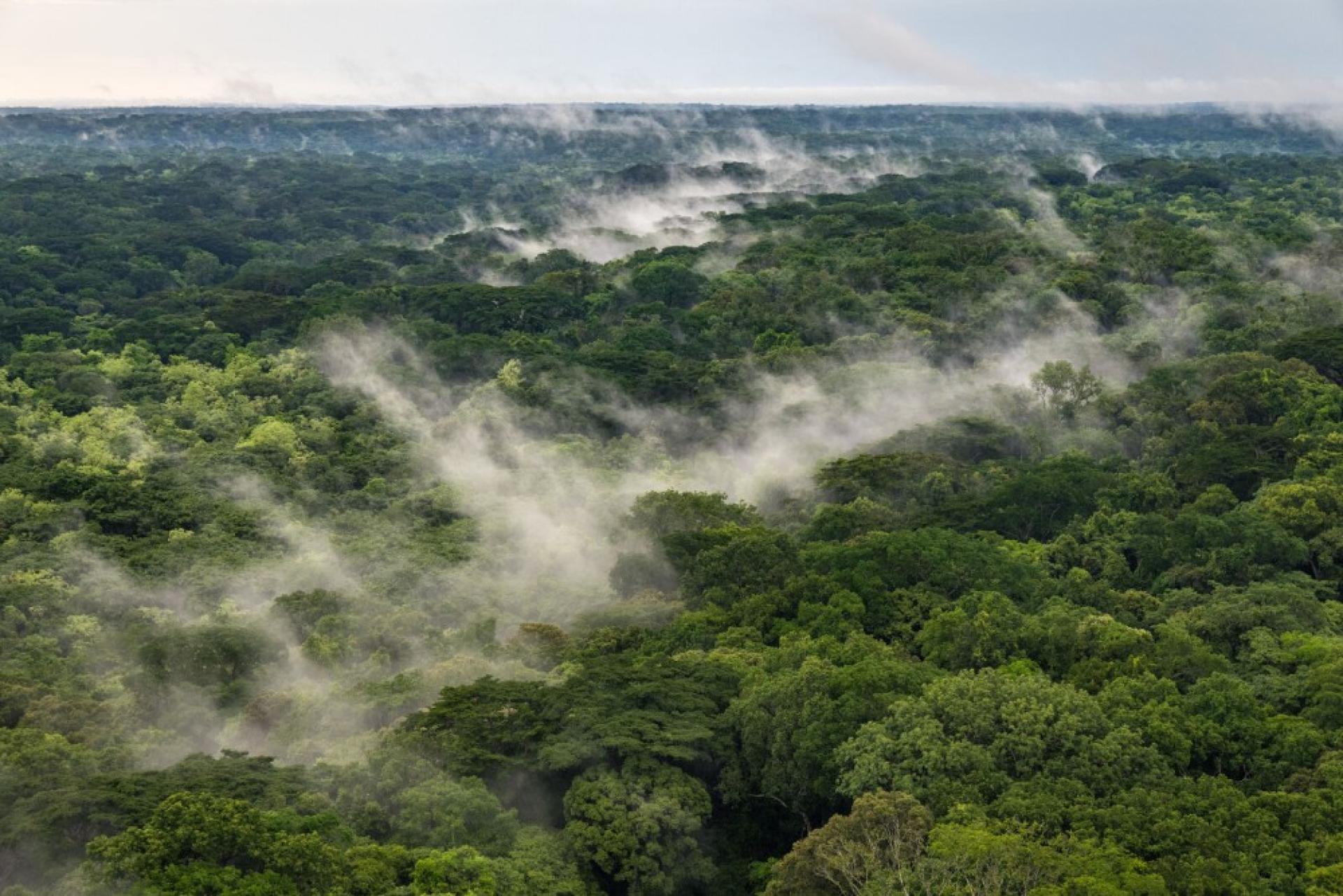
The GEF-funded Congo Basin IP, within UNEP’s Congo Basin Landscapes Initiative, supports the conservation and governance of vital landscapes in the Congo Basin Forest Biome. One of the Programme’s approaches to combating deforestation involves collaborating with local communities, national and regional government officials and international partners to develop comprehensive, trans-boundary land use management plans. The methodology to develop these plans is being enriched through the integration of natural capital accounting (NCA) principles, enabling a holistic understanding of socio-ecological and economic impacts.
Understanding Natural Capital Accounting
Natural capital accounting offers a globally recognized statistical framework for assessing stocks and flows of ecosystems and their services, helping decision-makers understand the long-term impacts of land use change. This approach facilitates informed trade-offs between conservation and development, providing relevant information about the contributions of nature to economy. Overall, natural capital accounting information allows better planning for development by recognizing the importance of natural assets in economic decision-making. Click here to view our Natural Capital Accounting Explainer.
The Congo Basin Landscapes Initiative, in partnership with UNEP-WCMC, has developed a supplemental land use planning methodology, which will be presented for approval to Central African governments through the Central African Forests Commission (COMIFAC). This methodology incorporates Natural Capital Accounting and climate change considerations into integrated land use management plans, offering a comprehensive roadmap for governments and communities in transboundary areas of the Congo Basin. Its goal is to balance conservation and sustainable development, enabling more informed and resilient land use decisions across the region.
The process to develop the enhanced methodology was collaborative, and involved multiple stages of research, technical development, and stakeholder consultation and engagement.
A comprehensive context analysis for natural capital accounting in the Congo Basin within the African continent and globally was completed in early 2024, providing a solid foundation for further work. During this period, the project also made strides in updating the NCA framework, adapting it to the specific needs and challenges of the region. A key milestone was the development of a draft methodology for integrated transboundary land use planning that included NCA principles and climate change considerations. To ensure broad support, relevance and co-development, the Initiative conducted extensive regional consultations and stakeholder engagement, gathering valuable insights and feedback in mid-2024. The COMIFAC secretariat and its respective working groups further reviewed and refined the methodology, bringing together expertise and input from various sectors. The supplemental guidance was revised by the drafting partners, UNEP-WCMC and United States Forest Services.
Next steps
The next steps to approve and endorse the enhanced methodology with the Central African Governments involves a high level process to approve the methodology by the Council of Ministers of Central African Governments for its rollout and implementation together with our partner COMIFAC. This will be followed by a regional consultation process, regional and national training sessions, and the establishment of a mentorship programme alongside the development and roll out of an online learning platform.
Concurrently, the project will select priority transboundary landscapes within the Congo Basin for pilot testing, where multi-disciplinary teams will apply the new integrated approach, including Natural Capital Accounting and climate change considerations. The pilot phase will involve rigorous documentation and evaluation to compile lessons learned to inform future revisions of the methodology. Building on these efforts, the project will develop a strategy for scaling up and mainstreaming the approach, engaging with national governments and international partners to integrate it into official land use planning processes. A robust monitoring and evaluation framework included in the supplemental guidance will track the effectiveness and impact of the new approach, enabling adaptive management and continuous improvement. These steps collectively aim to ensure the thorough validation, effective capacity building, practical testing, and strategic scaling of the enhanced land use planning methodology, including natural capital accounting principles and climate considerations across the Congo Basin.
More information
(1)What is integrated land use management planning ?
Integrated Land Use Management Planning (ILUMP) is an important tool to facilitate a comprehensive and collaborative approach to manage shared natural resources across national borders and is thus an important tool to combat degradation and deforestation in the Congo Basin Forest.
By bringing together regional governments and local communities in the planning process, ILUMPs create an opportunity to align diverse priorities and needs. This collaborative approach ensures that the resulting plans are not only ecologically sound but also socially and economically viable. For example, an ILUMP might incorporate sustainable forestry practices that preserve habitats for endangered species and plants, while also providing economic opportunities for local communities through carefully managed timber harvesting or non-timber forest product collection.
More information about the Congo Basin Landscapes Initiative here.