
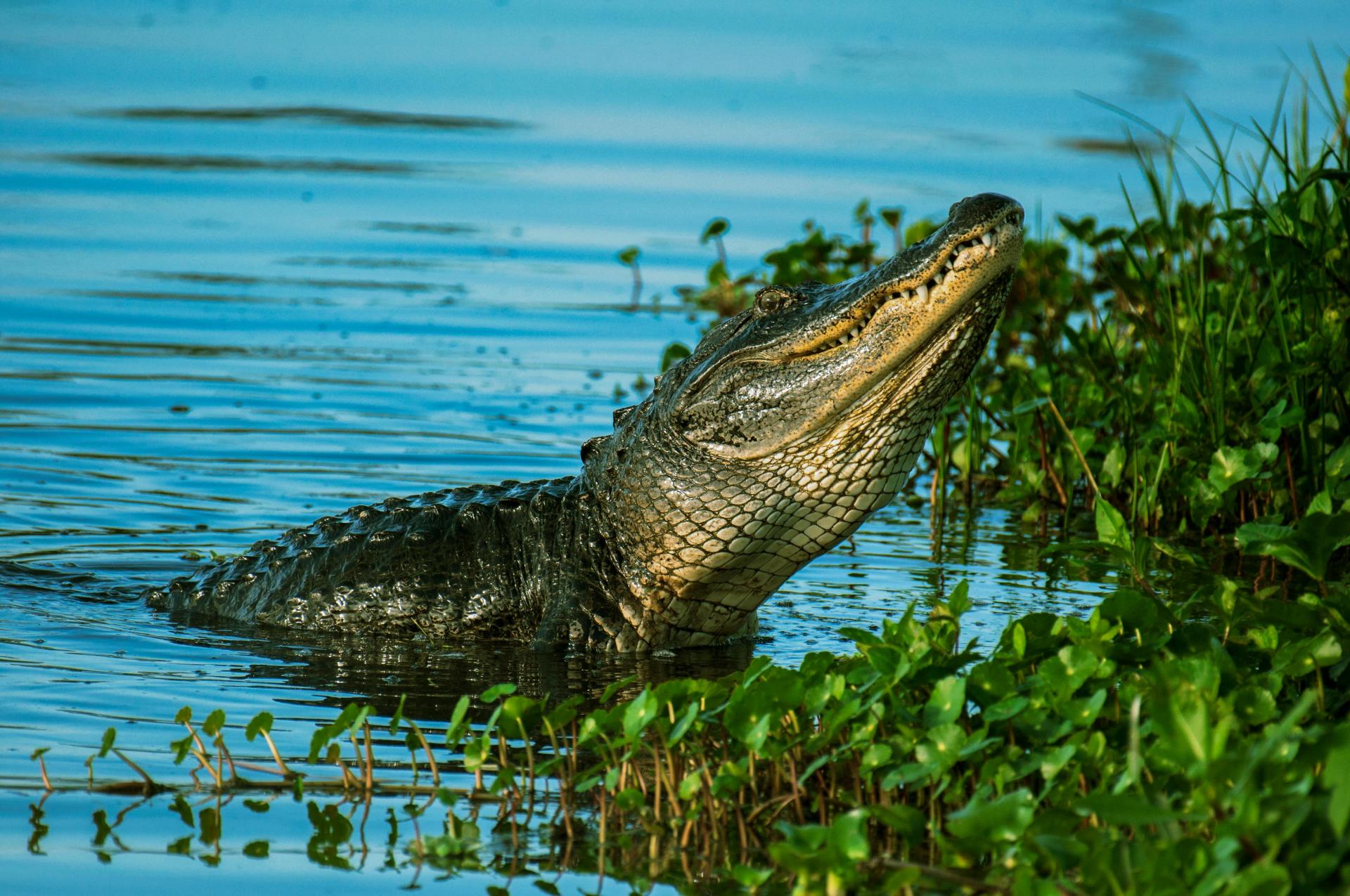
In the heart of Central Africa, in the Congo Basin, where ancient rivers wind through dense rainforests and floodplains stretch beyond the horizon, a quiet revolution in conservation is taking place. Deep within the Lac Télé Community Reserve (RCLT), a team of researchers armed with spotlights and GPS devices are conducting one of the most sophisticated crocodile monitoring programs ever undertaken in the Congo Basin.
As dusk settles over the water, the familiar glow of eye-shine pierces the darkness, the telltale sign of crocodiles floating just beneath the surface. For the Wildlife Conservation Society (WCS), which has partnered with UNEP [A1] through the Congo Basin Peatlands Project, funded by the International Climate Initiative (IKI), these nocturnal surveys represent far more than simple animal counting. [2] [3] [4] Each glowing pair represents indicators of ecosystem health, water quality, and the integrity of an entire landscape that millions of people depend on.
The work being conducted employs cutting-edge technology that would seem at home in a California startup. Satellite imagery from European Space Agency sensors provides 10-meter resolution views of the landscape, while sophisticated algorithms process vegetation indices and map suitable crocodile habitats with unprecedented precision. GPS coordinates are logged with sub-meter accuracy (±0.5m), and every piece of data flows into advanced database systems that can handle real-time analytics across the vast Congo Basin region.
But why focus on crocodiles? These apex predators serve as what scientists call "umbrella species", and protecting their habitat means protecting entire ecosystems. Crocodiles need clean water, abundant fish populations, and undisturbed nesting sites. When crocodile populations are healthy, it signals that rivers are unpolluted, fish stocks are sustainable, and human activities are balanced with natural processes.
For local communities in the Congo Basin, and specifically in the Lac tele surroundings, crocodiles are integral to daily survival and cultural identity. The crocodiles have sustained communities for generations through carefully managed traditional hunting practices, providing meat for special occasions and leather for crafts that generate income. When crocodile numbers decline, it often signals broader ecosystem degradation that threatens the very foundation of rural economic life.
The initial results of the crocodile counting are both encouraging and sobering. Surveys reveal crocodile densities ranging from 1.5 to 3.0 individuals per surveyed kilometer along different waterways, with the highest concentrations found at lentic-lotic transition zones, crucial areas that support incredible biodiversity. These hotspots, characterized by forest canopy cover exceeding 75% and minimal human disturbance, represent the crown jewels of the region's aquatic ecosystems.
The research also reveals the mounting pressures these systems face. Climate change is altering water levels, while growing human populations increase pressure for fishing, agriculture, and settlement. The sophisticated monitoring system being implemented as part of the IKI Congo Peatlands Project tracks these changes in real-time, providing early warnings when habitats begin to degrade.
The work aligns with global conservation targets set by the Kunming-Montreal Global Biodiversity Framework and contributes directly to Sustainable Development Goal 15.5, which calls for urgent action to reduce the degradation of natural habitats. By establishing rigorous monitoring protocols, the project creates a model that can be replicated across the entire Congo Basin, the world's second-largest tropical rainforest.
Perhaps most importantly, the initiative recognizes that effective conservation cannot happen without local communities. Traditional ecological knowledge held by indigenous peoples provides crucial insights that complement high-tech monitoring. Community members are being trained in species identification and data collection techniques, creating a network of local monitors who understand both the technology and the landscape in ways that outside researchers never could.
Looking ahead, the project is preparing for an ambitious expansion. Plans include extending surveys to under-explored waterways throughout the reserve and deploying underwater listening devices to capture crocodile vocalizations and movements that visual surveys might miss. These acoustic monitoring systems will provide 24-hour surveillance, revealing behavioral patterns that could be crucial for understanding how crocodiles adapt to changing conditions.
Community engagement will deepen through participatory mapping exercises, where local knowledge holders collaborate with scientists to validate habitat assessments and ensure that conservation strategies respect local cultural practices.
The goal is to create a seamless blend of traditional wisdom and modern technology, indigenous knowledge systems informing satellite data analysis, and scientific findings supporting community-based conservation decisions.
As the spotlight beams sweep across dark waters, each glowing pair of eyes represents evidence that with careful monitoring, community partnership, and technological innovation, it's possible to balance human needs with biodiversity conservation. In counting crocodiles, researchers are counting the pulse of one of Earth's most precious ecosystems, ensuring that future generations will still encounter those ancient, watchful eyes reflecting from waters in the Congo Basin.
For more information visit: www.congolandscapes.org