
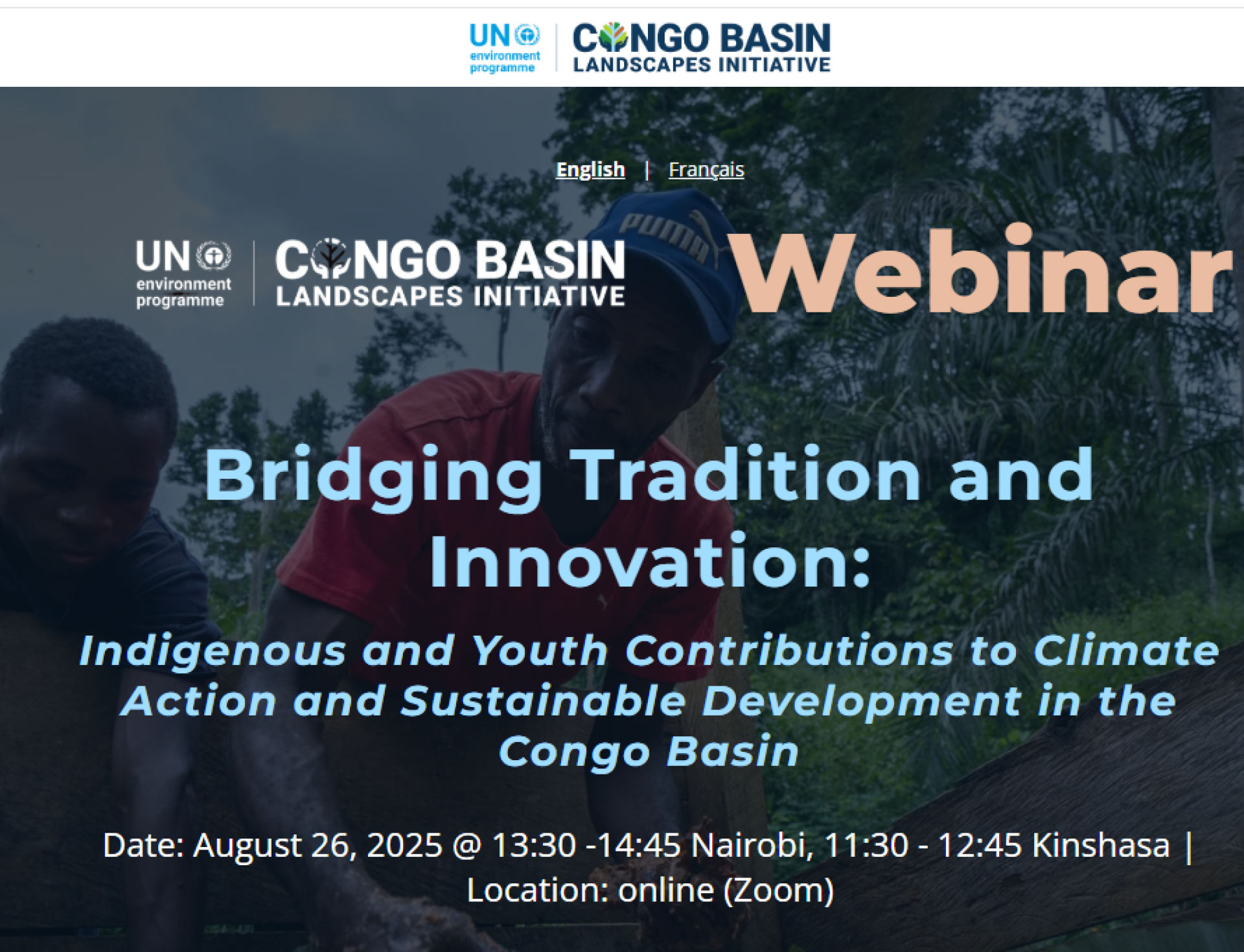
Indigenous Knowledge and Youth Leadership take center stage at Inaugural Congo Basin Voices Webinar Series

The Congo Basin Landscapes Initiative (CBLI) launched its inaugural "Congo Basin Voices" webinar series on August 26, 2025, bringing Indigenous Peoples’ representatives together with young conservationists and researchers from the Congo Basin to showcase innovative approaches to forest conservation in the world's second-largest tropical rainforest.
The 75-minute virtual event, attended by participants from Central and East Africa as well as Europe and the United States, highlighted successful models of integrating traditional ecological knowledge with modern conservation science across the 30-billion-ton carbon-storing ecosystem in the Congo Basin.
Community Networks Lead Conservation Efforts
Prescilia Monireh of ANAPAC-RDC presented the Democratic Republic of Congo's community-based approach, emphasizing how Indigenous women serve as the backbone of forest conservation. "Forests act as pharmacy, hospital, and market for our communities," Monireh explained, describing traditional practices including medicinal plant management and rotational forest use that demonstrate successful integration of livelihoods with conservation goals.
Her presentation showcased REPALEAC's sub-regional network spanning eight countries, where Indigenous governance structures rooted in ancestral knowledge provide effective frameworks for landscape-scale conservation that have sustained Congo Basin biodiversity for millennia.
Youth Scientists Bridge Traditional and Modern Approaches
Brice Tsafack, representing REJEFAC (Central African Forest Youth Network), outlined how the next generation combines cutting-edge scientific methods with community knowledge to create comprehensive understanding of critical ecosystems. The training programs, which focus on students and young scientists, ensures that they understand the importance of conservation and community partnerships.
Grace Mercia Bobangui, a young researcher involved in the Congo Basin Peatlands Project training activities, shared her experience working in the Cuvette Centrale peatlands, which store 29 billion tons of carbon equivalent to three years of global fossil fuel emissions. Speaking about the hands-on training involving early career researchers from regional universities, she emphasized how their research approach combines advanced mapping techniques with community-integrated field studies. MS Bobangui highlighted the need of researchers to collaborate with local communities and learn from their wealth of traditional knowledge. She emphasized that the researchers in her cohort are no longer just the future of conservation – they are its present.
Policy Framework Supports Indigenous Leadership
UNEP's Fabrice Inkonkoy highlighted recent policy developments, noting that following COP16's historic decision, Indigenous Peoples now have a formalized leadership role within the Convention on Biological Diversity framework. "Conservation succeeds when Indigenous Peoples are at the forefront," Inkonkoy stated, outlining UNEP's support for implementing these frameworks across the Congo Basin.
Marianna Osipova presented UNEP's "We Are Nature: Youth Biodiversity Challenge" currently piloting in Kenya and South Africa with ambitions to reach one million youth across 20 countries over five years. The initiative builds on the success of the Tide Turners Plastic Challenge, which engaged nearly one million young people across 61 countries.
Looking Forward
Annie-Claude Nsom, who moderated the session, outlined concrete collaboration opportunities including expanding Congo Basin peatlands training programs and scaling successful community conservation models across the region.
The quarterly webinar series continues with upcoming sessions focusing on natural capital accounting and innovative conservation financing mechanisms. All session materials will be added to the CBLI Community of Practice, with participants receiving access to the Community of Practice to facilitate ongoing collaboration.
The event highlighted the growing recognition of Indigenous communities and young researchers as essential partners and co-leaders in protecting one of the world's most precious ecosystems for climate stability.
More information: www.congolandscapes.org