
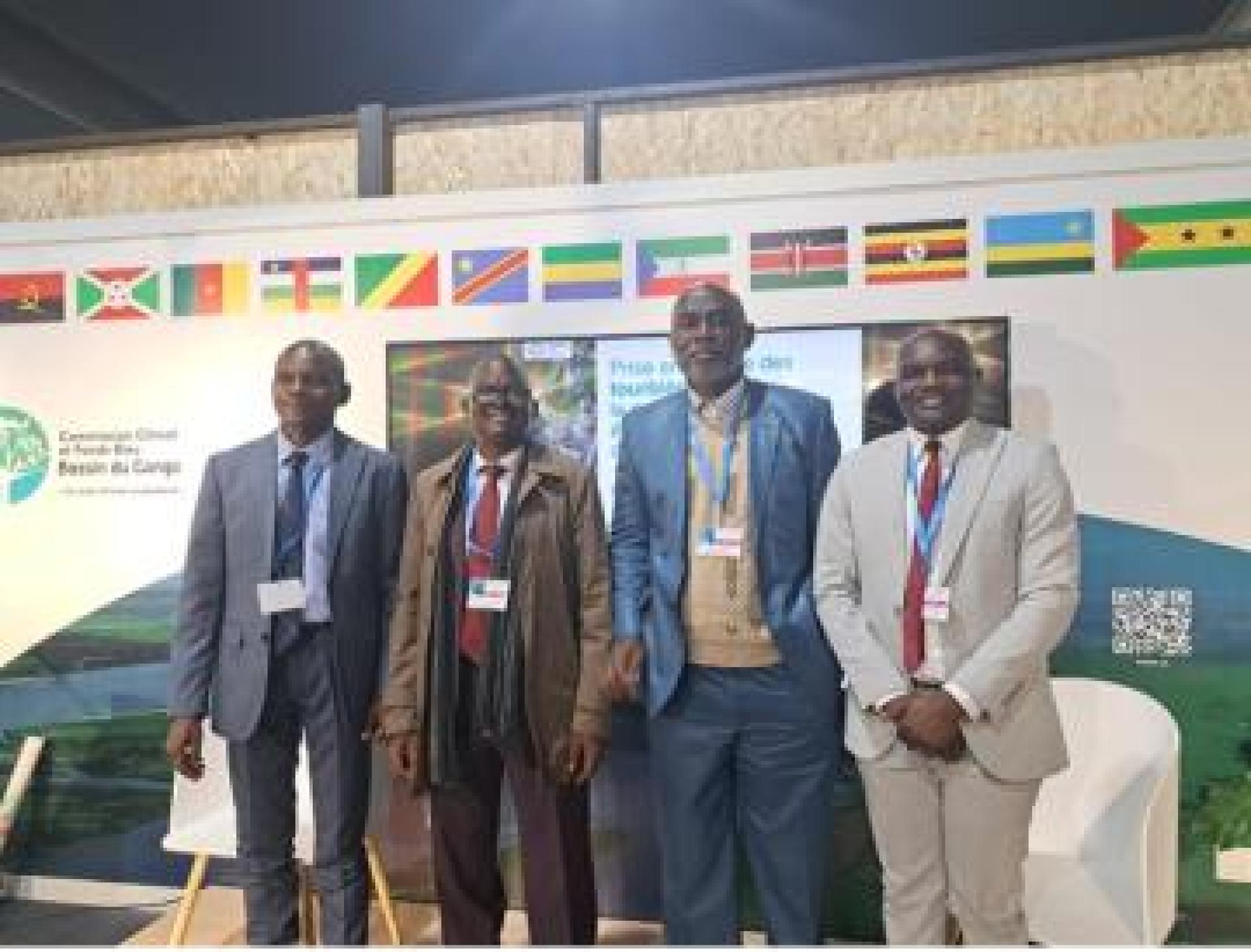
As part of the UNEP-led and IKI-funded project "Securing critical reserves of biodiversity, carbon and water in the Congo Basin peatlands through informed decision-making and good governance", a side event focusing on the integration of peatlands into the sustainable management of the Congo Basin ecosystems was co-organized at COP29 by the Ministries of Environment of RoC and DRC, with the support of UNEP and chaired by the Secretary General of the Ministry of Environment of DRC.
The Congo Basin peatlands straddle the Republic of Congo (RoC) and the Democratic Republic of Congo (DRC). The currently known estimate of the peatlands size is around 167 600 Km2, making it the largest continuous tropical peatland complex in the world. The peatlands are characterized by their rich biodiversity and their great capacity to store carbon, thus playing a crucial role to mitigate climate change. It is important to note that during this COP29 event organized by UNEP, one of the speakers, Professor Ewango, indicated the size could even be estimated at 175 000 Km2, based on their ongoing research. While waiting to confirm any new estimates, one take away message from the event is that efforts on research and mapping of the peatlands need to be emphasized in order to clearly and definitely establish their scope and size, thus facilitating management planning.
In addition to providing the information gleaned from mapping work currently being done and noted above, Professor Corneille Ewango a botanist of the university of Kisangani (DRC) provided an overview of scientific information available to date on the peatlands of the Central Congo Basin and Professor Ifo Suspense Averti of the university Marien Ngouabi (RoC), presented the challenges faced by peatlands. The two speakers highlighted the fact that the peatlands are particularly vulnerable to human activity, including logging, oil exploration, agriculture and the threat of climatic change. Disturbances that they undergo lead to the emission of large amounts of carbon dioxide, the main greenhouse gas responsible for climate change. They noted that several studies have been carried out since the identification of the sequestration capacity of peatlands, but much remains to be done to refine mapping, improve knowledge on fauna, flora and hydrology, reinforce the legal status of peatlands and enhance their natural capital. Jean Jacques Bambuta, the Coordinator of the Peatland Management Unit in the Ministry of the Environment in DRC focused his remarks on the work that needs to be done to develop and implement National Strategies to preserve peatlands.
After congratulating UNEP and IKI for their role in supporting the sustainable management of the Congo Basin Peatlands, an appeal was made to strengthen financial support to countries to enable more research initiatives, build a center of excellence on peatlands, train a critical mass of national experts and ensure the involvement of local communities and indigenous peoples.
More information about the Congo Basin Landscapes Initiative here.