
Enabling effective Public-Private-Partnerships is essential for engaging with communities and strengthening their participation and contribution in the conservation and sustainable management of the Congo Basin Forest. As part of the GEF-funded Congo Forest Integrated Programme, the UNEP-led Congo Basin Landscapes Initiative is strengthening the integrated management of Cameroon’s globally important forest landscapes to secure the region’s biological integrity and increase economic and livelihood opportunities for forest dependent people.
In the TRIDOM (Tri-National Dja-Odzala-Minkebe Transboundary Landscape) local communities depend heavily on forest resources. Their way of life is inextricably linked to the forest. With family farming one of the main causes of deforestation and forest degradation, supporting forest peoples to sustainably use Congo Basin forest resources while retaining their livelihoods is one of the Programme’s goals.
In the heart of the TRIDOM in Cameroon, and with funding from GEF, the CBSL Programme has partnered with the RainForest Alliance to support the certification of cacao cooperatives. The certification process is bringing local farmers together with international organizations who can provide the certification and connect farmers with rewarding markets for their certified products. This enables the local farmers to sell their cacao beans to local offtakers who then sell it on to international processors. These international businesses in turn sell the cacao for chocolate to organizations like Nestle and Cadbury. (Click here to hear Cedric Happy, of the RainForest Alliance explain what assurances the certification process provides to international buyers.)
One cooperative that is receiving training in these certification standards is the SCOOPS-PROCAM Cooperative (Societe Cooperative Simplifiée des Producteurs de Cacao de Mintom), located in the rainforest in southern Cameroon. Since being created in 2018, the SCOOPS-PROCAM Cooperative has grown from just 28 members to 186 members today. Profits have risen four-fold over this time and production has also increased. In 2018, the cooperative produced 16 tonnes, in the 2022-2023 season, the first in which they were certified, they produced and sold 58 tonnes to local offtakers.
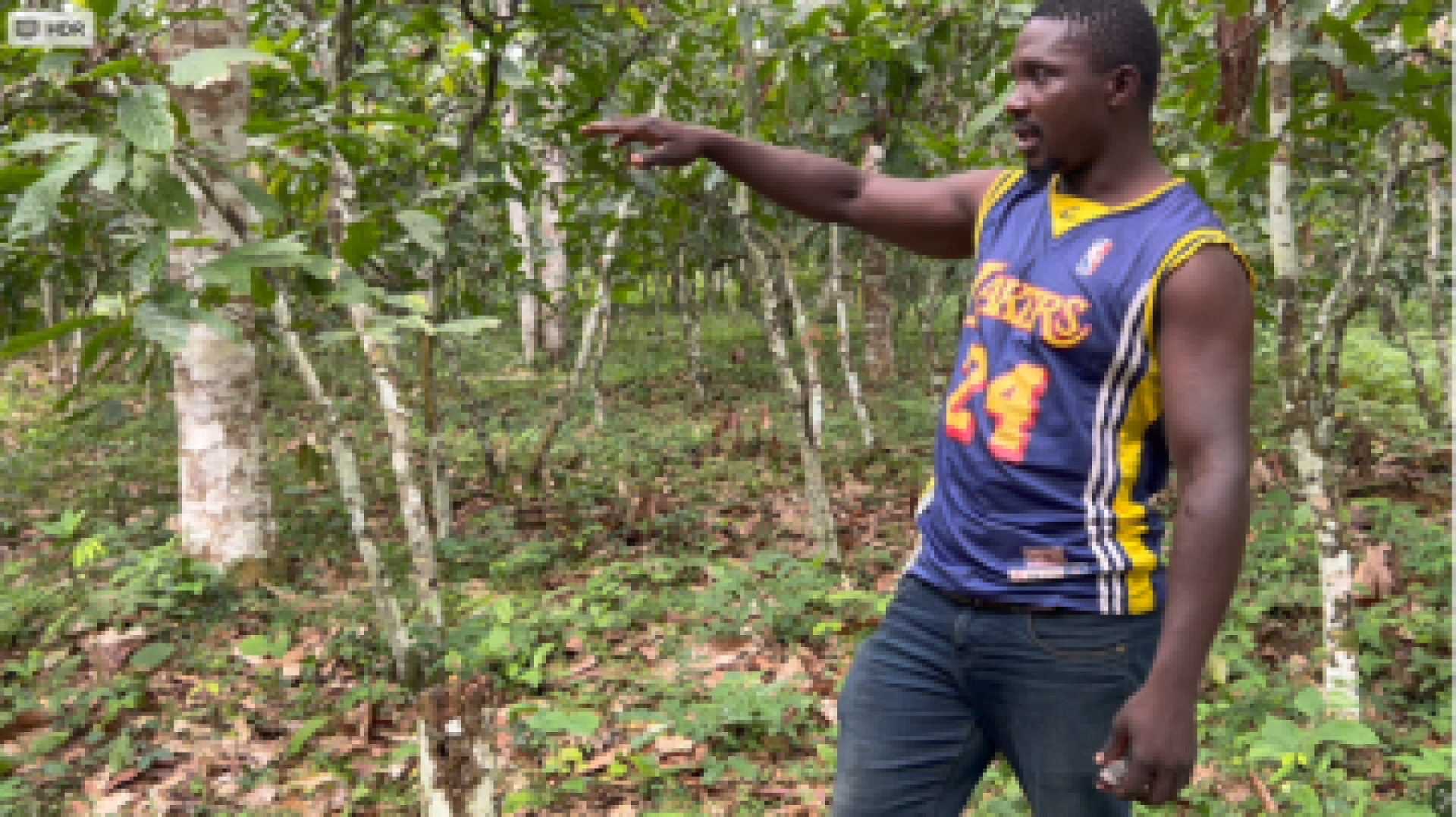
Tanguy Zame (pictured) leads one of the field schools that trains farmers who are members of the SCOOPS-PROCAM cooperative. Training in areas such as good agricultural practices and bookkeeping has enabled the SCOOPS-PROCAM Cooperative to nearly quadruple the amount being sold to offtakers in the last five years. SCOOPS-PROCAM currently sells to the offtaker, Telcar Cocoa LtdCorporation, who in turn sells to Cargill. In turn Cargill sells to Nestle, for use in their confectionary business.
The certification of the SCOOPS-PROCAM Cooperative to sustainably sell cocoa beans internationally is just one example of how the Congo Basin Landscapes Initiative is bringing together private sector partners with local communities, to support their livelihoods.
More information about the Congo Basin Landscapes Initiative here.