
The UNEP-led multi-partner and multi-country Congo Basin Landscapes Initiative, through the GEF-funded Congo Forest Integrated Programme, is working with governments and partners on different fronts to catalyse transformational change in conservation and sustainable management of critical forests in transboundary and national landscapes of the Congo Basin.
One of the main areas of the Programme is to enable and strengthen the integration of great apes and elephants into regional development processes. One of the strategies of the Programme to achieve this is through the development of enhanced integrated land use management plans to strengthen the transboundary landscapes governance, together with local communities and backed up by scientific data. The development of these plans requires governments, communities, scientists and the private sector to work together to develop workable plans built on science. Alongside supporting livelihoods for local communities, a key goal of these plans is to reduce the impact of large scale development projects on mammals, particularly great apes, and their habitats.
The scale of energy, extractive, agro-business and associated infrastructure projects in ape habitat in the Congo Basin totals billions of dollars. Conservationists to date have not been able to respond at the appropriate scale in terms of either the time or dedicated resources needed. There is an urgent need to develop teams in Congo Basin countries, where great apes range, to conduct Strategic Environmental Impact Assessments (SEIA), to respond to requests for expert advice and to fully engage with industry, governments, and multilateral donor institutions.
The ARRC (Avoid, Reduce, Restore and Conserve) Task Force, which sits within the Section for Great Apes (SGA)/Small Apes (SSA) of the Primate Specialist Group (PSG) of the Species Survival Commission (SSC) of the International Union for the Conservation of Nature (IUCN) and is fiscally sponsored by Re:wild, is responding to these challenges by strengthening the capacity of conservation professionals from the Congo Basin through its Primate WATCH program. These trainees can be called upon individually and as a team to engage with the private sector to reduce the impact of large scale development projects on great apes and other wildlife. These trainees were also able to exchange with the previous cohort of Primate WATCH participants from West Africa (2021-22) during a workshop that was held in Côte d’Ivoire, leading to the establishment of the Primate WATCH network. The mission of the network is to ‘promote the conservation of great apes by providing technical advice and support to minimise the negative impacts of large scale development projects’.
To date, eight primatologists (two women and six men) from Cameroon, the Democratic Republic of Congo, Gabon and Republic of Congo (2 per country) have learnt, among other topics, about the mitigation hierarchy, environmental impact assessment process, best practice standards and certification schemes (e.g. Forest Stewardship Council (FSC)), the various stages and impacts of large-scale development projects and associated infrastructures, what constitutes an appropriate baseline survey or offset for great apes, and mitigation measures that could be implemented at different stages of a project.
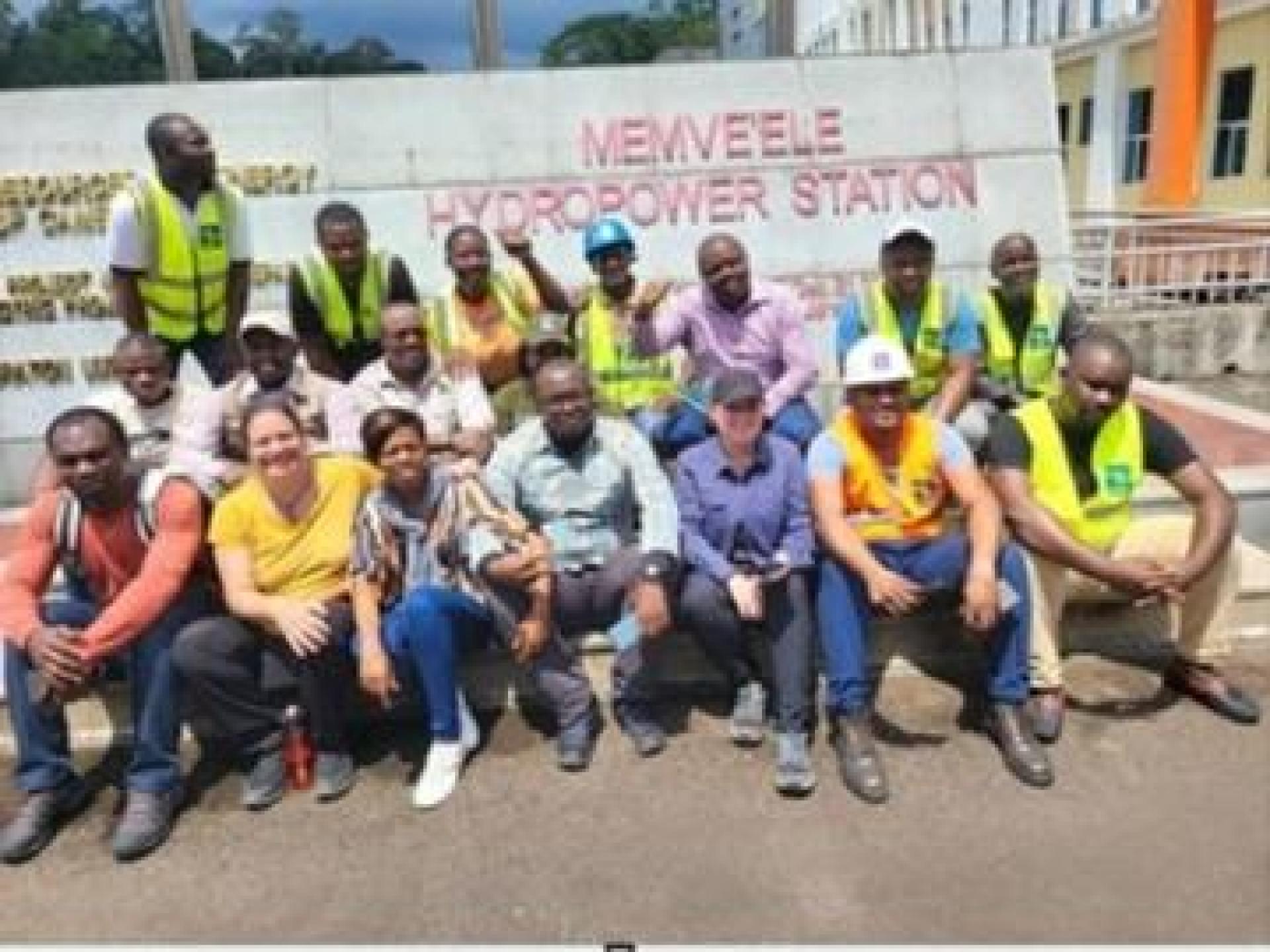
Their training has included three in-person workshops, one held in Cameroon in November 2022, the second in Gabon in May 2023, and a third one in Côte d’Ivoire in September 2024 which aimed to reinforce knowledge-sharing among West and Central Africa participants and facilitate a road map for the creation of the Primate WATCH Network. These workshops enhanced the participants’ practical experiences and understanding of the impacts of different types of large-scale development projects. Visits were organised for participants to hydrodam projects, agro-industrial projects, an FSC logging concession and a road upgrade project located in great ape habitat.
The Primate WATCH Central Africa participants also attended nine virtual sessions, in addition to the three in-person workshops to enhance technical training. The participants benefited from interventions from external speakers, including representatives from the International Finance Corporation (IFC), The African Development Bank (AfDB), The Biodiversity Consultancy (TBC) and an expert on Forest Stewardship Council (FSC) certification
At the end of the training period, the primatologists will participate in actual assessments of infrastructure projects and their impact on biodiversity. The information they glean will inform the land use management plans being developed by the Congo Forest Integrated Programme.
More information about the Congo Forest Integrated Programme and the Congo Basin Landscapes Initiative here.