
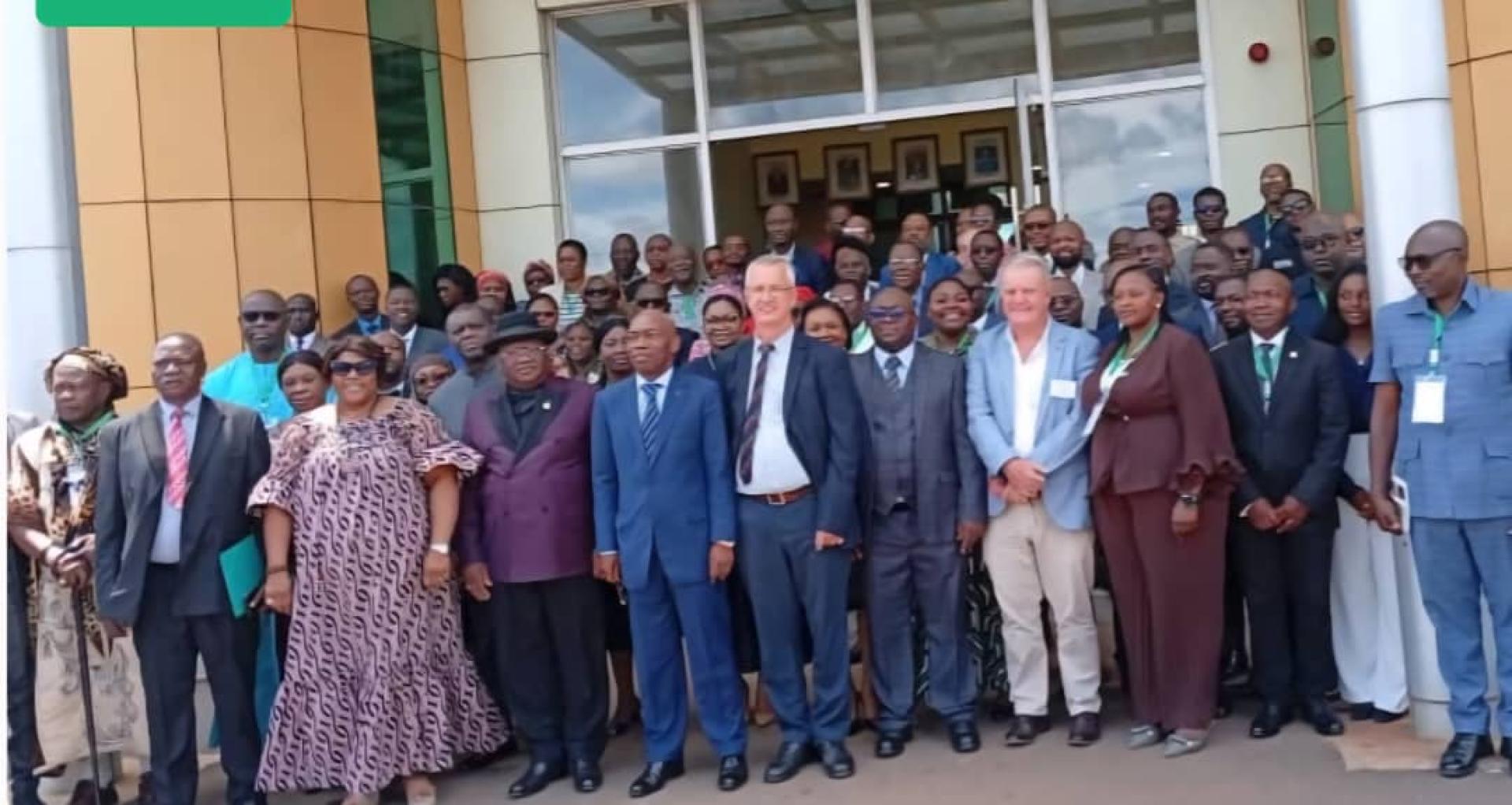
From 17 to 18 September 2026, the Sub-regional Forum for the technical validation of the third edition of COMIFAC’s Convergence Plan 2026–2035 (PC3) was held in a hybrid format at the headquarters of the Central African Forest Commission (COMIFAC) in Yaoundé, in the Republic of Cameroon.
Chaired by His Excellency the Minister for Forests and Wildlife of the Republic of Cameroon, the Forum was organised by the COMIFAC Executive Secretariat. The event received technical and financial support from the United Nations Environment Programme (UNEP), through the Congo Basin Integrated Landscape Impact Programme funded by the Global Environment Facility (GEF-7), as well as from the European Union (EU), through the OFAC-CE Project.The overall objective of the Forum was to examine and technically validate the draft COMIFAC Convergence Plan 2026–2035, whilst strengthening political support, national ownership and the collective commitment of stakeholders to its future implementation.
Specifically, the aim was to:
• review and validate the vision, strategic directions, key innovations, four strategic priorities and thirty-six targets of the PC3;
• review and validate the Operational Plan and the Regional Investment Programme (PRI) 2026–2030, including its seventeen flagship programmes and the strategy for mobilising resources and investments;
• to review and approve the PC3’s framework for governance, implementation, performance and accountability;
• to agree on recommendations and a roadmap designed to ensure political ownership of the PC3, the mobilisation of all stakeholders and the effective launch of its implementation.
The opening ceremony, presided over by His Excellency Mr Jules Doret NDONGO, Minister for Forests and Wildlife of Cameroon, featured addresses by Dr Stephen PEEDELL, representative of the European Union, Mr Fabrice INKONKOY LOPILI, Biodiversity Programme Manager at UNEP, and Dr Hervé Martial MAIDOU, Executive Secretary of COMIFAC, as well as the official opening address delivered by the Minister.
Following the formal ceremony, the Forum’s Bureau was established with the following composition:
Chair: Mr Joseph NYONGWEN, Secretary-General of the Ministry of Forests and Wildlife, Republic of Cameroon;
1st Vice-Chair: Ms Pascaline MBANGU KIKUMB, Secretary-General of the Ministry of the Environment, Sustainable Development and the New Climate Economy, Democratic Republic of the Congo;
2nd Vice-Chair: Mr Julien KOULAREMBAYE KONDJA, Secretary-General of the Ministry of the Environment, Fisheries and Sustainable Development, Republic of Chad;
1st Rapporteur: Ms AYISSATOU INA, representative of the Director-General of Forests at the Ministry of Water and Forests, the Environment and Climate, responsible for Human-Wildlife Conflict, Gabonese Republic;
Second Rapporteur: Mr Célestin BOUSSIENGUE, COMIFAC National Coordinator, Republic of the Congo;
Secretariat: COMIFAC Executive Secretariat.
The election of the bureau was followed by the adoption of the agenda and a series of plenary presentations focusing on the three components of the draft PC3, namely: the Strategic Framework 2026–2035; the Operational Plan and the Regional Investment Programme (RIP) 2026–2030; and the Framework for Governance, Implementation, Performance and Accountability.
Following these presentations, discussions continued in plenary in a spirit of constructive dialogue, mutual listening and shared responsibility. These were followed by an in-depth review of the draft PC3 within three thematic working groups. The conclusions of their work, presented in plenary, led to the identification of the following key messages:
- A coherent strategic framework: PC3 is an ambitious, unifying instrument that is fully consistent with sub-regional, African and international commitments, notably the Kunming–Montreal Global Biodiversity Framework, the Paris Agreement, the Sustainable Development Goals (SDGs), the African Union’s Agenda 2063, and African strategies on forests and biodiversity;
- A robust programme framework: the PRI’s structure, comprising four (4) strategic pillars, twenty-six (26) priorities, thirty-six (36) targets and seventeen (17) key programmes, provides a common and robust operational basis for the conservation, sustainable management and enhancement of Central Africa’s forest ecosystems;
- A clarified governance framework: the proposed framework sets out a clear institutional architecture, whilst providing the necessary details on coordination, monitoring and evaluation, and risk management mechanisms;
- Inclusive and representative participation: the meeting brought together all stakeholders in an inclusive manner (Member States, regional organisations, technical and financial partners, multilateral financial institutions, UN agencies, civil society, indigenous peoples, local communities, the private sector and the scientific community);
- A technical consensus in favour of consolidation: the three working groups identified priority amendments and editorial adjustments to be incorporated into the final version, without calling into question the overall framework, demonstrating a genuine convergence of views on the Plan’s fundamental orientations.
At the conclusion of the proceedings, the participants carried out the technical validation of the 2026–2035 Convergence Plan (PC3), subject to the incorporation of the amendments proposed and adopted in the plenary session. They also adopted the roadmap setting out the next steps for the finalization and political adoption of the document.